 Quail Corner

What Size Ground Pen for Quail (2026)
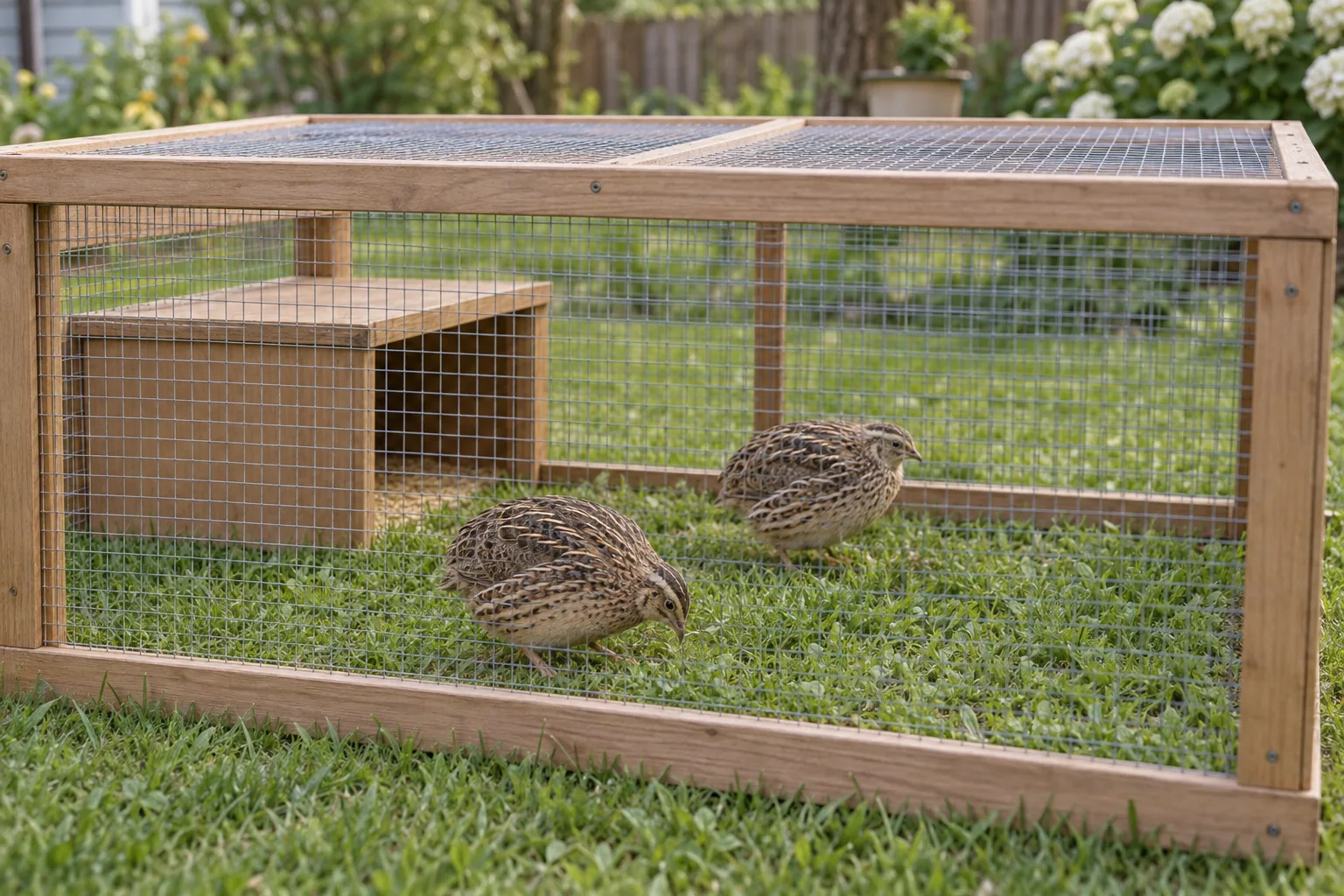
Start with 2 ft² of usable ground area per Coturnix bird or more. That means at least 4 ft² for two birds, 8 ft² for four, and 12 ft² for six. Buy for the floor the birds can actually use, not the flock size printed in a listing.
This guide works through the footprint first, then covers mesh, roof, shelter, shade, ground security, and the choice between a finished run and DIY hardware cloth. For ready-made recommendations, see best quail ground pen (2026): 7 Backyard Picks, which checks footprint, mesh, cover, and predator details.
What size ground pen do Coturnix quail need?
Use 2 ft² per bird or more for a ground pen or aviary. That is a different planning rule from wire cages, where 1 ft² per bird is the minimum. A ground setup needs room for movement, foraging, shelter, and dry areas, so the cage figure is too small for this decision.
| Format | Best for | Space starting point | What it still needs |
|---|---|---|---|
| Finished ground run | A quick setup for a small covey | 2 ft² per bird or more | A predator and weather inspection |
| Panel exercise pen | A flexible frame to cover and improve | 2 ft² per bird or more | Quail-safe mesh, roof, shelter, and secure edges |
| DIY mesh enclosure | A custom footprint or larger yard | 2 ft² per bird or more | Frame, fasteners, door, roof, shelter, and drainage plan |
Finished runs
A finished run is the easiest route when you have a small flock and want doors, a frame, and an outdoor footprint in one purchase. The Kecreque A-Frame Coop with Run is a useful sizing example: its listed dimensions are 47 x 18 x 19.5 inches, or about 5.9 ft² before shelter or blocked corners are removed. The listing says it suits quail, yet that footprint does not provide 8 ft² for four birds under the ground-pen rule.
Panel pens
Panel pens make a useful starting frame when you want to change the layout or store it between uses. They are rarely a complete quail system. Add a covered top, check the opening size, secure every panel connection, and give the birds a dry refuge before treating the setup as housing.
DIY mesh enclosures
DIY is the best choice when the yard decides the footprint. The YARDGARD 1/2-Inch Hardware Cloth is a material example with 19-gauge galvanized steel, a 24-inch by 25-foot roll, and double-zinc coating. It is not a finished pen. You still need a frame, roof, door, fasteners, and shelter.
If a raised outdoor cage fits your routine better, compare Best Outdoor Quail Cage (2026): 7 Weather-Ready Picks for weather-ready alternatives that keep birds off the ground.
Which type of ground pen fits your flock and yard?
Your labor budget matters as much as the cash price band. The $ tier can suit a pair or small covey, while a $$ material bundle gives you more control. A $$$ build makes sense when the yard and flock justify a larger custom footprint.
| Price band | Typical route | Best fit | Check before buying |
|---|---|---|---|
| $ | Compact finished run or basic panel base | A pair or small covey with room for improvements | Usable floor, mesh, roof, shelter, and latch |
| $$ | Folding run or larger mesh bundle | A keeper who wants portability or a custom layout | What is included, how edges fasten, and where shade comes from |
| $$$ | Large covered run or full custom build | A dedicated yard area or growing flock | Drainage, cleaning access, roof strength, and local predator pressure |
Do not confuse a material roll with a complete enclosure. A roll of mesh can be the budget winner if you already have a frame and tools. If you need birds housed quickly, the extra value in a finished run is the saved construction time, not a promise that the listing’s flock claim is correct.
What should you check before buying a quail ground pen?
Check the usable footprint, then inspect the details that keep a ground setup workable. These are the mistakes that create an undersized or exposed pen:
- Using cage math. A wire cage minimum of 1 ft² per bird does not size a ground pen. Start at 2 ft² per bird or more.
- Counting the shelter as open floor. Subtract fixed boxes, partitions, and blocked corners from the dimensions.
- Buying mesh by its label. Confirm 1/2-inch hardware cloth for adults or 1/4-inch wire for chicks, then inspect seams and fastening.
- Skipping the roof. Birds still need shade and weather cover when they can forage on the ground.
- Trusting “outdoor” as a complete setup. Check the base, latch, roof, shelter, drainage, and access yourself.
For the mesh, latch, seam, roof, and ground-contact inspection in one place, use How to Predator Proof a Quail Cage: 7 Steps.
How do ready-made runs compare with DIY ground pens?
Ready-made runs save cutting and measuring. DIY gives you footprint control and lets you choose the frame, roof, door, and ground edge. Pick the format that reaches the 2 ft²-per-bird floor rule and leaves you with a pen you will actually maintain.
For specific ready-made recommendations, see best quail ground pen (2026): 7 Backyard Picks. If you decide ground access is more work than you want, Best Quail Cage (2026): 6 Verified Picks for Every Flock covers above-ground options.
The practical buying order is simple: count birds, calculate usable floor, choose the format, then verify mesh, cover, shelter, and ground security. Do not reverse that order because a compact listing looks convenient.
How do you keep the pen dry, shaded, and predator-conscious?
Keep the shelter dry and draft-free, cover the run, and provide shade that does not block airflow. Secure the lower edge, close gaps around doors, and check the roof after wind. A ground pen needs daily observation because wet bedding, shifted panels, or a loose latch can change the risk quickly.
That is the difference between a run and a complete outdoor system. The frame gives the birds an area to occupy. You still provide the weather plan, the secure boundary, and the maintenance routine.
Frequently asked questions
how big should a quail ground pen be
Allow 2 ft² per Coturnix bird or more in a ground pen. Measure the usable floor, then remove space taken by fixed shelter, partitions, or corners the birds cannot reach. A wire cage uses a separate minimum of 1 ft² per bird, so do not use that smaller figure here.
quail ground pen square footage
Multiply the usable length by the usable width in feet. Two birds need at least 4 ft², four need at least 8 ft², and six need at least 12 ft². Subtract built-in shelter or blocked sections before deciding how many birds the pen can hold.
how many quail per ground pen
Divide the usable square footage by 2 and round down. An 8 ft² usable pen gives a planning floor for four Coturnix, while a 12 ft² pen gives six. Treat that result as a planning floor, not a seller’s maximum capacity.
What mesh size is safe for a quail ground pen?
Use 1/2 x 1/2-inch hardware cloth for standard adult quail and 1/4-inch wire for chicks. Inspect the roof, seams, door edges, and ground contact too. A correct mesh opening does not secure a pen if predators can lift, chew, or push through the frame.
Does a ground pen need a roof and shelter?
Yes. Cover the top, provide a dry draft-free refuge, and add shade. Ground access gives birds room to forage, yet it does not protect them from rain, wind, cold, or summer heat. Coturnix housing can be fine to about 20°F when dry and draft-free, while heat stress is a concern above about 90°F.
Is a ready-made quail pen better than DIY?
A ready-made run saves cutting and framing time, while DIY gives you control over the footprint, mesh, roof, and access points. Check what the word kit means. It can describe a finished run or a bundle of mesh and parts that still needs a frame, door, fastening, roof, and shelter.