 Quail Corner
What Size Outdoor Quail Cage? A Practical Sizing Guide
The right size depends on your Coturnix count and the type of outdoor housing. Start with 1 ft² per bird minimum for a raised wire cage, 1.5 ft² per bird as the kinder target, or 2 ft² per bird or more for a ground pen or aviary.
Those figures describe usable floor area, not a seller's maximum capacity. This guide shows how to work out the footprint, account for stacked tiers, and check the roof, shade, mesh, latches, airflow, and cleaning access before you buy.
Which type of outdoor quail housing fits your setup?
Choose a raised wire cage for easy tray access, a covered cage for a sheltered location, or a ground pen for more movement. The same cage needs a different plan under a shed roof than it does in direct weather. Start with these space rules, then read the outdoor requirement column before shopping.
| Housing type | Space rule | Best fit | Outdoor requirement | Main tradeoff |
|---|---|---|---|---|
| Raised wire cage | 1 ft² per bird minimum, 1.5 ft² kinder | Elevated cleaning and egg collection | Cover from rain, sun, wind, and predators | Less room for natural movement |
| Covered cage or enclosed shelter | Use the wire-cage rule for each usable floor | Shed, roofed porch, or covered run | Shelter supplies the weather barrier, shade, and airflow plan | The cage depends on the surrounding structure |
| Ground pen or aviary | 2 ft² per bird or more | More movement and a walk-in style setup | Roof, secure mesh, latches, drainage, and ground checks | More work against digging, dampness, and predators |
Is a raised wire cage suitable outdoors?
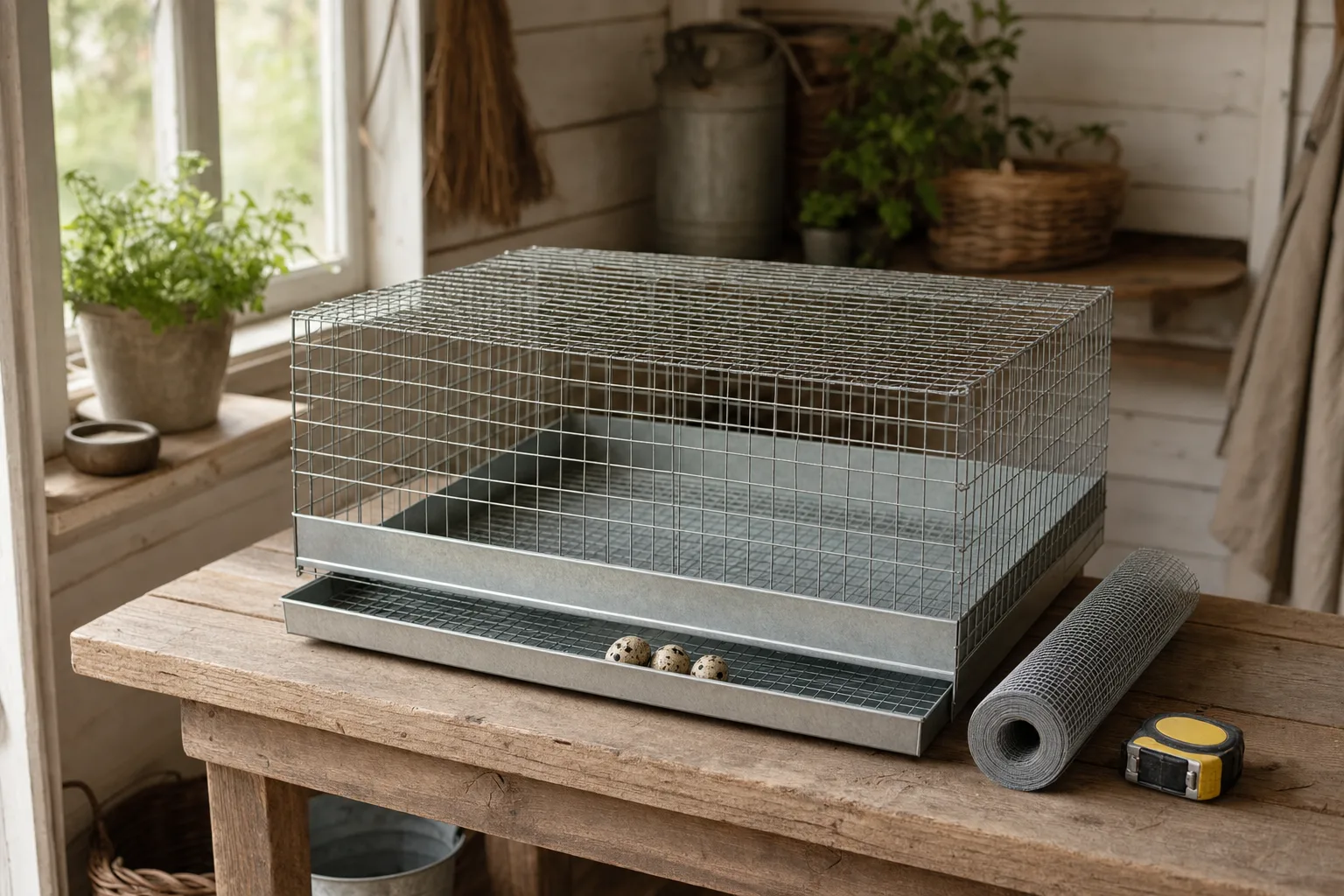
It can work under a roof or inside an enclosed shelter: a three-section two-layer jumbo cage covers a larger covey, and a two-section single-layer cage suits a smaller group without wasting floor space. Each bird gets at least 1 ft² of usable wire-cage floor, and 1.5 ft² is a kinder target. Raised housing makes manure trays and eggs easier to reach, though the cage still needs protection from precipitation, direct sun, wind, and predators.
What changes with a covered cage or shelter?
A shed roof, covered porch, or roofed run supplies protection that the cage itself may lack. You can choose the cage around usable floor area and your daily workflow, then make sure the shelter stays dry, shaded, ventilated, and secure. Read our quail housing guides for the wider setup decision.
When does a ground pen or aviary make sense?
Use 2 ft² per bird or more when the birds will live on the ground in a pen or aviary. This gives more room for movement, yet it increases the jobs around drainage, roof integrity, mesh, corners, latches, and ground contact. Project Upland's Above-Ground versus Ground Housing for Pen-Raised Quail is a useful comparison of that raised-versus-ground choice.
Once you know your footprint and exposure level, compare our quail cage picks in the roundup best outdoor quail cage (2026): 7 weather-ready picks.
Which budget tier matches the work you want to do?
Choose a tier by completeness, not by the biggest bird count printed on a listing. A $ cage can suit a practical keeper who will add shelter and inspect control points. Higher tiers can reduce daily work, though modular parts still need a careful inventory.
| Price band | What it may include | What you must verify | Best fit |
|---|---|---|---|
| $ | Basic cage or wooden hutch | Roof, shade, mesh, latches, floor, and drainage | Keeper who can inspect and improve the setup |
| $$ | Better access, trays, shelter compatibility, or a sturdier ready-made arrangement | Exposure limits, predator details, and usable floor area | Keeper wanting a more workable daily routine |
| $$$ | Larger or modular systems and a more complete workflow | Every supplied part, since an addition is not a standalone pen | Larger flocks or planned expansion |
What sizing mistakes should you avoid?
- Counting stacked tiers as one floor. Each level has its own usable area. Calculate the floor on every level rather than combining the vertical footprint.
- Trusting the vendor count. Work out floor area from the dimensions and compare it with 1 ft² minimum per bird for wire housing, or 2 ft² per bird or more for ground housing.
- Taking 'outdoor' literally. A listing can still need a roof, shade, drainage, airflow, and added protection from wind and rain.
- Skipping the predator inspection. Check latches, seams, corners, mesh, roof, and ground access before birds arrive.
- Choosing height over workflow. A tall pen needs a soft roof, and a floor without workable cleaning access can turn into a chore you avoid.
Where can you compare outdoor cages?
Use your calculated floor area and exposure plan first. Then visit the roundup that compares 7 weather-ready cages for specific products, listing details, and the tradeoffs between high-capacity systems and lower-cost outdoor-positioned hutches.
Frequently asked questions
What is the best quail cage for outdoors?
The Hatching Time unit featured in the anchor roundup is the strongest high-capacity choice for a covered outdoor setup. GOJOOASIS is the lower-cost listing explicitly positioned for outdoor use. Neither label replaces a roof, shade, secure latches, and a careful predator check.
Is a quail cage for outdoors different from an indoor cage?
Yes. Outdoor use needs weather cover, shade, drainage, predator resistance, and ventilation around the cage. A rust-free plastic body can help with cleaning, yet it does not automatically make an indoor-rated system suitable for exposed weather.
Can quail live outside in winter?
Coturnix can be fine to about 20°F when housing stays dry and draft-free. Your cage still needs protection from wind, precipitation, and dampness, so monitor local conditions instead of treating a product label as a cold-weather guarantee.
How much space do outdoor quail need?
For a ground pen or aviary, allow 2 ft² per bird or more. A wire cage needs 1 ft² per bird minimum, with 1.5 ft² as the kinder target. A vendor capacity claim can exceed what its usable floor area supports.
Do outdoor quail cages need a roof?
Yes. A roof keeps off rain and snow, adds shade, and gives predators one more barrier. Cages taller than 8–12 in need a soft roof because startled birds can hit their heads. Leave enough open area for airflow.
Is a wooden quail hutch predator-proof?
No product should be treated as automatically predator-proof. Inspect mesh openings, latches, seams, roof, corners, and ground contact, then reinforce weak points for local predators before relying on the hutch outdoors.