 Quail Corner

What Size Fan for Quail Coop (2026): CFM Guide
There is no universal CFM-per-quail rule. For a small open wire cage, shade and passive cross-ventilation may solve the problem; for a mostly enclosed coop or shed, choose an exhaust fan by enclosure shape, vent path, power source, and safe placement.
Fans move air. They do not refrigerate it. The best starting point is the smallest dependable setup that removes stale, damp air without blowing across the birds. For the full solar-versus-electric shortlist, see best quail coop fan (2026): 8 Solar & Electric Picks, including airflow, power, controls, and weather-resistance comparisons.
Fan types compared
Pick the fan type by the housing, not by the number of quail alone. A low wire cage, a screened outdoor coop, and a shed have different air paths and different installation risks.
| Fan type | Best fit | Main strength | Main catch |
|---|---|---|---|
| Passive vents | Open cages and sheltered coops | No power or moving parts | Cannot force air on still, hot days |
| Solar fan | Outdoor housing without mains power | Simple daytime exhaust | Output follows sun and panel placement |
| Battery-backed solar | Outdoor coops needing cloud or night backup | Solar power with stored energy | Runtime is limited and listing-dependent |
| AC exhaust or inline | Sheds and fixed installations | Consistent power and control | Needs safe wiring and a suitable opening |
Passive ventilation
Passive ventilation is the right first move for a small open wire cage. Put the cage under shade, keep screened openings clear, and arrange the housing so air can enter one side and leave another. eXtension's ventilation guide describes air exchange that removes moisture, dust, odors, and stale air.
Solar-only fans
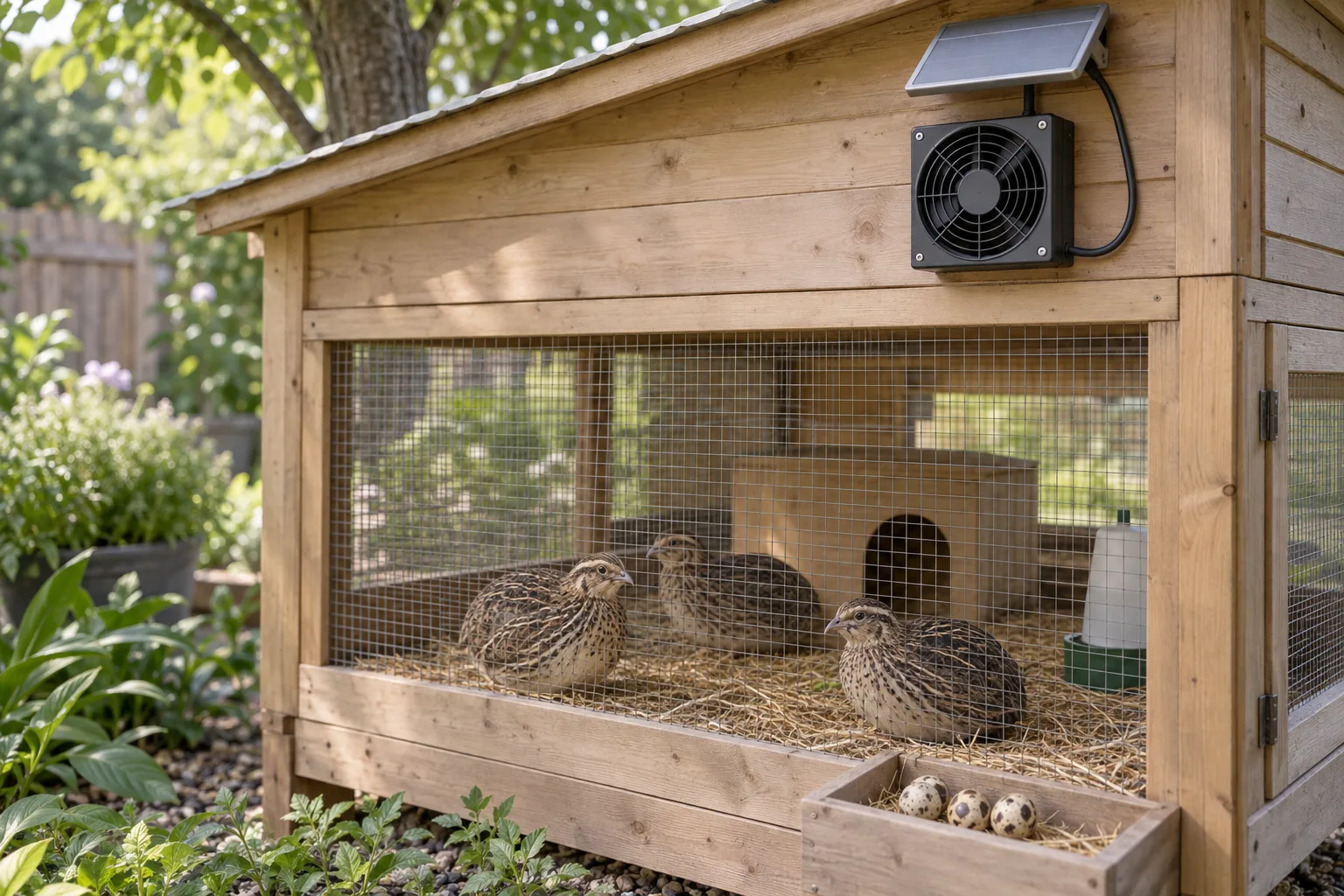
A solar-only fan suits a shed or covered coop that mainly needs daytime exhaust. It avoids a mains run, yet its output depends on sunlight, panel angle, and cloud cover. Treat it as daytime help, not night protection.
Battery-backed solar kits
A battery-backed kit gives an outdoor keeper more useful coverage through clouds or after sunset. It still has a finite runtime, so read the listing carefully and decide what happens after the battery is empty. This is often the sensible middle ground when running AC power is awkward.
AC wall and inline fans
AC exhaust is the dependable choice for an enclosed shed with a safe wall opening or duct route. Wall fans suit a direct exhaust path. Inline fans suit ducted housing where you want the motor away from the birds. Either needs a guard, protected cable, and replacement-air opening.
Budget tiers
Price bands help set expectations without pretending a cheap fan solves every enclosure. Spend first on a safe air path and dependable power, then add controls and weather protection.
| Tier | What you get | Best use |
|---|---|---|
| $ | Simple solar fan or basic electric fan | Daytime exhaust or a small screened setup |
| $$ | Better controls, battery backup, or a quieter inline design | Most outdoor coops and modest enclosed housing |
| $$$ | Hybrid power, stronger exhaust, thermostat control, or a planned duct system | Larger enclosed housing with a permanent installation |
Common mistakes to avoid
- Buying by bird count. Quail count alone cannot size a fan. Look at enclosure volume, openings, shade, heat, and the route air must travel.
- Blowing across the birds. Aim toward an upper exhaust point and keep a sheltered retreat instead of turning the cage into a wind tunnel.
- Ignoring passive ventilation. A fan cannot fix a sealed housing with no replacement-air opening. Clear the screens and plan intake before increasing output.
- Assuming solar means all-night power. A solar-only unit follows daylight. Check for a battery, listed runtime, and a backup plan.
- Cutting an unsafe opening. Every new fan hole needs a tight guard, secure mesh, protected cable, and a weather-resistant mount. Use How to Predator Proof a Quail Cage: 7 Steps for a checklist that keeps the opening from becoming an entry point.
A practical example: SUNYIMA 20W Solar Dual-Fan Kit
For a small or medium outdoor enclosure where a permanent mains run is inconvenient, the SUNYIMA kit is the contextual pick. Its listing gives two 4.7-inch fans, up to 2 × 120 CFM, a 20W panel, a 6600mAh battery, temperature-sensor modes, 5–8 hours of listed runtime, and IP65 protection. Those specifications describe the kit, not a guaranteed coop capacity.
The battery makes it more useful through clouds or after sunset than a solar-only fan. It is still a ventilation aid, not an air conditioner, and the fans should not point at the quail. Omlet's Smart Chicken Coop Fan Support Center makes the same distinction: moving air is not the same as actively lowering the coop's temperature. Mount the exhaust high, keep the wiring protected, and confirm that replacement air can enter safely.
Choose a different route if the housing needs a large wall cutout, continuous AC operation, or a ducted installation. For those decisions, compare the solar and electric options in best quail coop fan (2026): 8 Solar & Electric Picks.
Heat management comes first
Penn State's hot-weather poultry guidance treats moving air as one part of heat management and cautions against blocking air movement with shade structures. Start with shade, water access, and a housing design that lets birds choose a calmer area. If you see concerning changes in behavior or condition, talk to a veterinarian or extension office rather than trying to solve a health problem with a bigger fan.
For more housing and ventilation guidance, continue to Quail housing guides.
Frequently asked questions
How many CFM for a quail coop?
There is no dependable CFM-per-quail rule. Size the fan around the enclosure, its passive openings, and the air path. A small open wire cage may need shade and cross-ventilation rather than powered exhaust, while an enclosed shed needs a fan matched to its vent opening and power plan.
How do I choose a quail coop fan?
Choose the smallest practical exhaust setup that moves stale air out without blowing across the birds. Check the fan type, verified CFM, power source, controls, weather protection, guard, cable route, and replacement-air path before you buy.
What size ventilation fan for quail works in a small cage?
A small cage usually needs gentle, indirect airflow rather than a large wall fan. Start with shade, screened openings, and a clear path for air to leave. Add a modest fan only when the housing stays hot or stale despite those changes.
Do quail coops need a fan?
A fan is useful in a hot, damp, or mostly enclosed coop, yet it is not mandatory for every setup. Open wire housing with shade and good cross-ventilation can exchange air passively. Heat stress begins above about 90°F, so watch conditions instead of sizing by bird count.
Should a quail coop fan run at night?
Night operation depends on the enclosure and power source. Solar-only fans stop when available power falls, battery-backed kits can continue for their listed runtime, and AC fans can run continuously if safely installed. Use a thermostat or timer when suitable, and keep airflow off the birds.
How do I stop a fan from blowing directly on quail?
Aim the fan at an upper exhaust opening or use ducting and a baffle so air crosses the housing above the birds. Leave a sheltered retreat. Penn State poultry housing guidance also stresses that vents and openings should not create drafts directly over the flock.