 Quail Corner

Best Quail Coop Fan (2026): 8 Solar & Electric Picks
The best quail coop fan for most small outdoor setups is the SUNYIMA 20W Solar Dual-Fan Kit. Its 20W panel, 6600mAh battery, temperature sensor, IP65 protection, and two 4.7-inch fans give you useful air exchange without running mains power to the coop.
A properly placed fan helps exchange warm, damp air. It does not refrigerate the enclosure like an air conditioner. Your choice comes down to the coop's size, passive openings, power access, night needs, and how easily you can keep the airflow off the birds.
Quick picks for quail housing
Ranked by scale fit, power reliability, controls, weather protection, and safe airflow.
Overall
Best for most small outdoor enclosures
- 6600mAh battery backup
- Temperature sensing
- IP65 protection
- Two 4.7-inch fans
Top Pick SUNYIMA 20W Solar Dual-Fan Kit
$$
Solar ventilation with useful cloud and night backup.
Check Price on Amazon Premium
Best for a larger enclosed coop
- 764 CFM listed airflow
- Solar plus AC adapter
- Four speeds
- Thermostat control
Top Pick HG Power 12-Inch Solar Exhaust Fan
$$$
Strong exhaust with dependable mains fallback.
Check Price on Amazon Electric
Best for a permanent wall install
- 820 CFM listed airflow
- Variable speed
- Thermal control
- Galvanized steel frame
Top Pick iLiving ILG8SF10V-ST 10-Inch Fan
$$
A practical wired choice where cutting a wall is acceptable.
Check Price on AmazonQuick answer: Buy SUNYIMA 20W Solar Dual-Fan Kit for a small or medium outdoor enclosure where battery backup matters. Pick HG Power 12-Inch Solar Exhaust Fan for stronger exhaust and AC fallback in a larger enclosed housing. Choose iLiving for a permanent wired wall install, or AC Infinity for a quieter ducted shed setup.
Before adding a fan, check the housing itself. Best Quail Cage (2026): 6 Verified Picks for Every Flock covers practical housing choices and the floor-space considerations that decide whether your birds need more ventilation room. Coturnix need at least 1 ft² per bird in a wire cage, with 1.5 ft² kinder, so crowding can make a fan seem like the fix when the cage is the real problem.
Quick picks
Our Top Picks


Comparison table
| Product | Best for | Price band | Key spec | Verdict |
|---|---|---|---|---|
| SUNYIMA 20W Solar Dual-Fan Kit | Small and medium outdoor quail coops needing solar ventilation with night/cloud backup | $$ | Up to 2 × 120 CFM | Check price |
| HG Power 12-Inch Solar Exhaust Fan | Larger enclosed housing needing strong exhaust, thermostat control, and AC backup | $$$ | 764 CFM | Check price |
| iLiving ILG8SF10V-ST 10-Inch Fan | A permanent, wired wall installation where thermostat and speed control matter | $$ | 820 CFM | Check price |
| AC Infinity CLOUDLINE S6 | Enclosed sheds or ducted setups where lower noise and speed control beat a large wall opening | $$ | 402 CFM | Check price |
| KEN BROWN 12-Inch Shutter Fan | A low-cost wired wall exhaust option for a larger, well-screened enclosure | $ | 1450 CFM | Check price |
| Fanspex 10-Inch Solar Exhaust Fan | Daytime-only solar exhaust on a small shed or coop with good passive airflow | $ | Up to 380 CFM | Check price |
| FlexSolar 12W Dual Solar Fan Kit | Small outdoor setups needing simple, low-cost solar circulation or intake/exhaust flexibility | $ | Two solar-powered fans | Check price |
| MARBERO 15W Dual Solar Fan Kit | Beginners who want two small guarded fans and flexible intake/exhaust placement | $ | Two solar-powered fans | Check price |
How we evaluate
Airflow has to match the enclosure. A high-output wall fan can make sense in a closed shed, while a small cage needs gentler exhaust that does not turn the bird area into a wind tunnel. We look for a real exhaust path, usable mounting, and a guard that keeps feathers and toes away from moving parts.
eXtension's ventilation guidance defines ventilation as exchanging indoor and outdoor air to remove moisture, dust, odors, and stale air. Its small-scale housing guidance also pairs adequate ventilation with dry, draft-free housing. That is why we look at the path the fan creates, not just the CFM number on the listing.
Power reliability matters just as much. Solar-only fans work during useful sunlight and depend on panel placement. A battery helps through clouds and after sunset. AC fallback helps when hot weather lasts longer than the stored charge. Thermostats, automatic shutters, backflow valves, speed control, weather protection, cable routing, and noise all decide how easy the fan is to live with. Omlet's Smart Fan explanation makes the key distinction clear: ventilation moves air, while an air conditioner actively lowers temperature.
Individual product reviews
1) SUNYIMA 20W Solar Dual-Fan Kit: best overall
This is the one I would start with for a typical outdoor Coturnix cage or compact coop. The two 4.7-inch fans can serve a screened exhaust path, and the listing gives up to 2 × 120 CFM. That is a useful scale for improving air exchange without starting with a large wall cutout.
The built-in battery is the difference here. Its 6600mAh capacity and listed 5–8 hours of continuous operation give the fan a better chance through a cloudy spell or part of the night. Automatic temperature mode, a 20W monocrystalline panel, and IP65 construction make it easier to use in an outdoor setup. It still needs a clear panel position and a sheltered, guarded fan route.
Pros
- ✓ Battery backup for clouds and some night use
- ✓ Temperature sensing and continuous modes
- ✓ No permanent mains run
Cons
- ✗ Not a substitute for passive openings
- ✗ The listing runtime is not all-night insurance
- ✗ Two small fans suit modest housing, not a big shed
2) HG Power 12-Inch Solar Exhaust Fan: premium hybrid
HG Power is the upgrade when the housing is genuinely enclosed and needs stronger exhaust. The 12-inch shutter fan lists 764 CFM, four speed levels, a thermostat, and a 10-minute shutoff delay. That control is more useful than simply buying the biggest fan you can find.
This is a solar and AC hybrid, so you can use the 40W bifacial panel when conditions suit it and the included adapter when dependable power matters. There is no battery. The 6.9 x 14.5 x 14.5-inch body also needs a proper wall opening, screening, and support. Skip it for a small wire cage unless you have a clear exhaust plan.
Pros
- ✓ Strong listed exhaust for larger housing
- ✓ Thermostat and four speed levels
- ✓ AC fallback when solar is unreliable
Cons
- ✗ No battery backup
- ✗ Requires a substantial wall installation
- ✗ Overkill for many open cages
3) iLiving ILG8SF10V-ST 10-Inch Fan: best electric wall fan
Choose iLiving when the coop already has safe mains power and you want a set-and-adjust wall fan. Its listed 820 CFM, variable speed, and thermal control give you more control than a basic on/off extractor. The 32–130°F control range also covers the temperatures a keeper is likely to worry about.
The galvanized steel frame, aluminum shutters, and wall-mount design suit a fixed installation. The trade-off is the permanent route: keep the cable dry, protect the opening with suitable mesh, and make sure the fan cannot direct air straight across the birds. Under 65 dB on the listing is quieter than some large fans, though a quiet motor cannot fix a poor mounting location.
Pros
- ✓ Strong electric airflow
- ✓ Variable speed and thermal control
- ✓ Shutter fan format
Cons
- ✗ Needs 115V power and fixed mounting
- ✗ Requires a carefully screened opening
- ✗ No solar or battery option
4) AC Infinity CLOUDLINE S6: best quiet inline

The CLOUDLINE S6 fits a different job. It is a 6-inch inline duct fan with a wired 10-speed controller and a listed 402 CFM, so you can place the motor away from the cage and run ducting to an exhaust point. That is useful in an enclosed shed where a big square wall fan would be awkward.
Its listed 32 dBA noise level is the main draw, along with the PWM-controlled EC motor. IP44 protection means it belongs in a dry, sheltered route rather than exposed weather. Plan the duct exit and intake before buying, and keep both ends guarded. This is a neat solution for a shed, less useful for an open wire cage.
Pros
- ✓ Quiet listed operation
- ✓ Ten speed settings
- ✓ Ducted motor can sit away from birds
Cons
- ✗ Needs duct planning
- ✗ IP44 calls for sheltered placement
- ✗ Less convenient than a small solar kit
5) KEN BROWN 12-Inch Shutter Fan: high-output budget electric

KEN BROWN is for a larger, well-screened enclosure where you want a lot of exhaust from a straightforward wall fan. The listing gives 1450 CFM from a 55W motor, with automatic louvers that close when the fan is off. Those shutters help reduce backflow and keep the opening from acting like an always-open hole.
That output makes scale fit critical. It is a poor match for a low wire cage if the air stream reaches the birds, and the 12-inch opening demands careful mesh work. Use the automatic thermal protector as a safety feature, not as a reason to skip a proper switch, guard, sheltered cable, or passive intake route.
Pros
- ✓ Highest listed airflow here
- ✓ Automatic louvers close when off
- ✓ Straightforward wired wall format
Cons
- ✗ Too forceful for many small cages
- ✗ Needs careful screening and mounting
- ✗ No battery or solar backup
6) Fanspex 10-Inch Solar Exhaust Fan: budget solar exhaust

Fanspex is a sensible low-cost route for daytime exhaust when the coop has good passive airflow and a sunny panel position. The 10-inch fan lists up to 380 CFM, a 25W IP67 panel, a brushless motor, and an anti-backflow valve. That valve helps limit reverse airflow when the fan is idle.
There is no battery backup. Treat this as a daytime helper, not a night ventilation plan. The waterproof on/off connector and 16.4-foot cable make placement easier, yet the large fan still needs a guarded opening and a route that keeps the moving air off the quail.
Pros
- ✓ Simple solar exhaust setup
- ✓ Anti-backflow valve
- ✓ IP67 panel and long cable
Cons
- ✗ Solar only
- ✗ No thermostat or battery listed
- ✗ Needs strong daylight for useful output
7) FlexSolar 12W Dual Solar Fan Kit: best budget dual kit
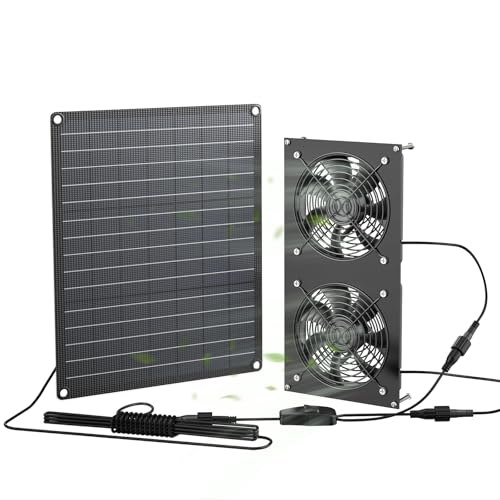
FlexSolar gives a small outdoor setup two solar-powered fans and independent on/off control for each one. That lets you use one as intake and one as exhaust, or run only the fan that suits the weather. The IP65 design and included mounting hardware keep the installation simple.
The 12W panel and up-to-2500 RPM listing describe a basic solar kit, not a stored-power system. It has no battery backup, so clouds and darkness stop being minor details. I would use it for daytime circulation or exhaust in a small, open housing, with shade and passive openings doing the main work.
Pros
- ✓ Two fans with independent switches
- ✓ Simple mounting hardware included
- ✓ Useful budget daytime option
Cons
- ✗ No battery backup
- ✗ No thermostat listed
- ✗ Performance depends on panel light
8) MARBERO 15W Dual Solar Fan Kit: flexible budget kit

MARBERO is the flexible beginner kit. Its two fans can be set as exhaust, intake, or one of each, and the metal protective nets are a welcome feature around birds. The 15W monocrystalline panel and cable length up to 13 feet give you room to put the panel in sun while keeping the fans under cover.
Like FlexSolar, it is solar only and has no built-in battery. That makes it a daylight tool. Use the flexible placement to improve air exchange in a small enclosure, then rely on shade, shelter, and open mesh for the hours when the panel is not producing power.
Pros
- ✓ Fans can be intake, exhaust, or mixed
- ✓ Metal protective nets
- ✓ Useful cable reach for panel placement
Cons
- ✗ No battery backup
- ✗ No thermostat listed
- ✗ Not a dependable night solution
Frequently asked questions
What is the best fan for quail coop?
The SUNYIMA 20W Solar Dual-Fan Kit is the best fit for many small outdoor quail enclosures. Its two moderate-output fans, temperature mode, IP65 construction, and 6600mAh battery give you useful ventilation without a permanent mains run. It is a ventilation aid, not an air conditioner.
What is the best quail coop ventilation fan?
Choose the HG Power 12-Inch Solar Exhaust Fan for a larger enclosed coop that needs stronger exhaust and AC fallback. Choose the iLiving 10-Inch Fan for a permanent electric wall mount. A small open cage often needs shade and clear passive openings before it needs either large fan.
What is the best solar fan for quail coop?
SUNYIMA is the best solar pick because its battery covers clouds and some night use. Fanspex is a simpler daytime exhaust option, while FlexSolar and MARBERO suit small setups where basic solar airflow is enough. Solar-only fans stop being useful when the panel is shaded or the sun is down.
Do quail coops need a fan?
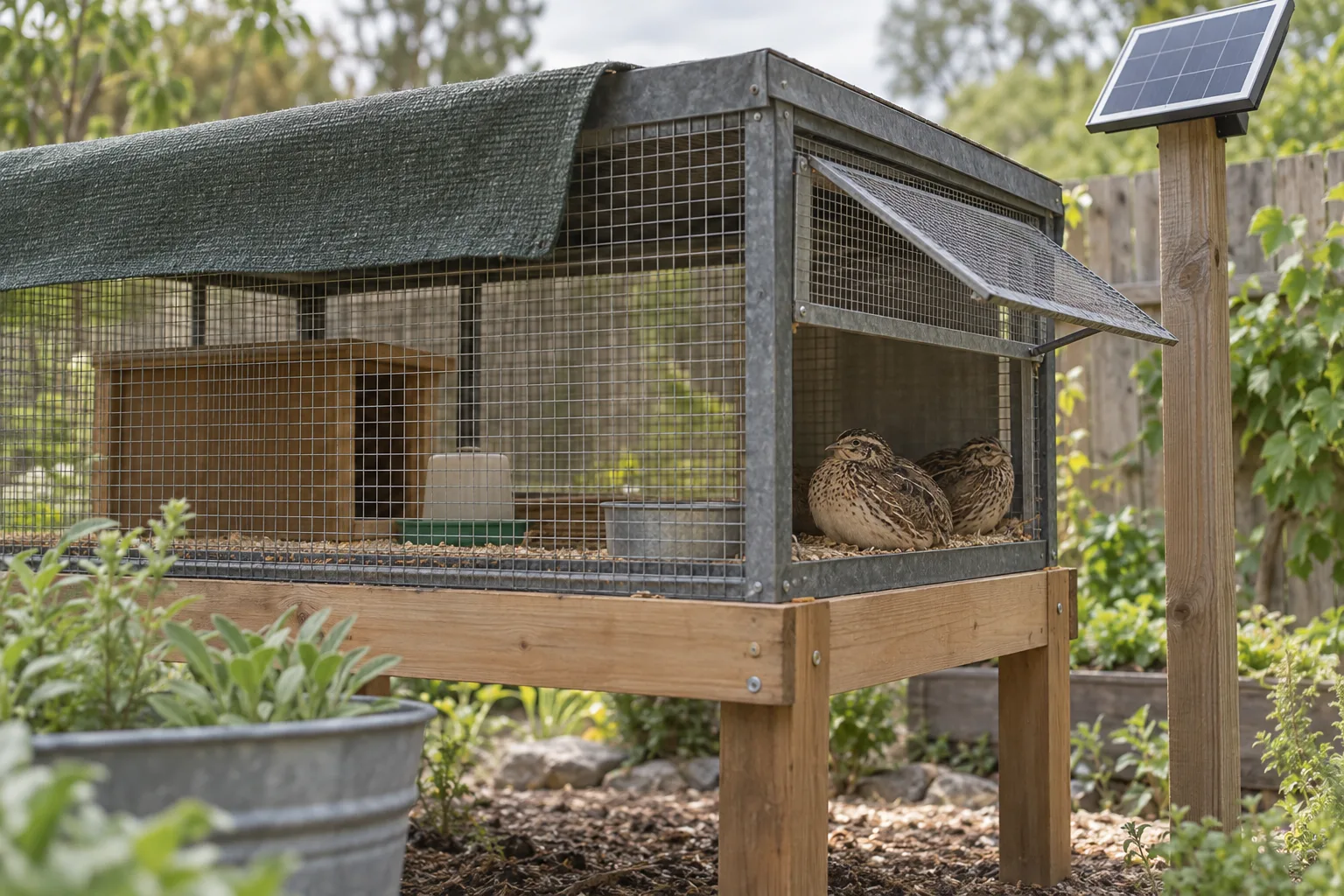
No, many open wire cages do well with shade, dry shelter, and openings that let stale air leave. A fan helps when an enclosure gets hot, damp, or stuffy, especially as heat stress rises above about 90°F. Keep air moving around the housing and away from a direct blast on the birds.
Should a quail coop fan run at night?
Run it at night only if the enclosure needs continued air exchange and the fan can do that safely without chilling or blowing directly on the birds. Battery backup makes SUNYIMA more useful after sunset. Solar-only Fanspex, FlexSolar, and MARBERO models cannot provide dependable night ventilation without stored power.
How do I stop a fan from blowing directly on quail?
Place the fan high or outside the bird zone, aim it through an exhaust opening, and use a guard over every blade or opening. Let replacement air enter from a shaded opposite side instead of pointing the fan at the cage. Watch the birds and adjust if feathers stay ruffled or they avoid the airflow.
Related guides
- Best Quail Cage (2026): 6 Verified Picks for Every Flock for cage size and practical housing choices.
- How to Set Up an Outdoor Quail Cage (2026) for shelter, shade, and airflow planning.
- How to Predator Proof a Quail Cage: 7 Steps for mesh, openings, and cable safety.
- More quail housing and ventilation guidance for the next setup decision.