 Quail Corner
What Size Tray for Quail Eggs (2026): Capacity and Fit Guide
The right size tray for quail eggs depends on the job. Pick a 12-count closed carton for ordinary household storage and selling, a 30-count carton for bulk batches, or a 90-egg open flat for collection and staging.
Capacity is only half the answer. Cell fit, lid protection, labels, stacking, outside dimensions, and compatibility with your refrigerator or carrier decide whether a tray works after the eggs leave the coop. This guide helps you choose before you buy. For a full comparison of open flats, lidded cartons, capacity, protection, and value, see Best Quail Egg Trays (2026): 7 Storage Picks.
What types of quail egg trays are available?
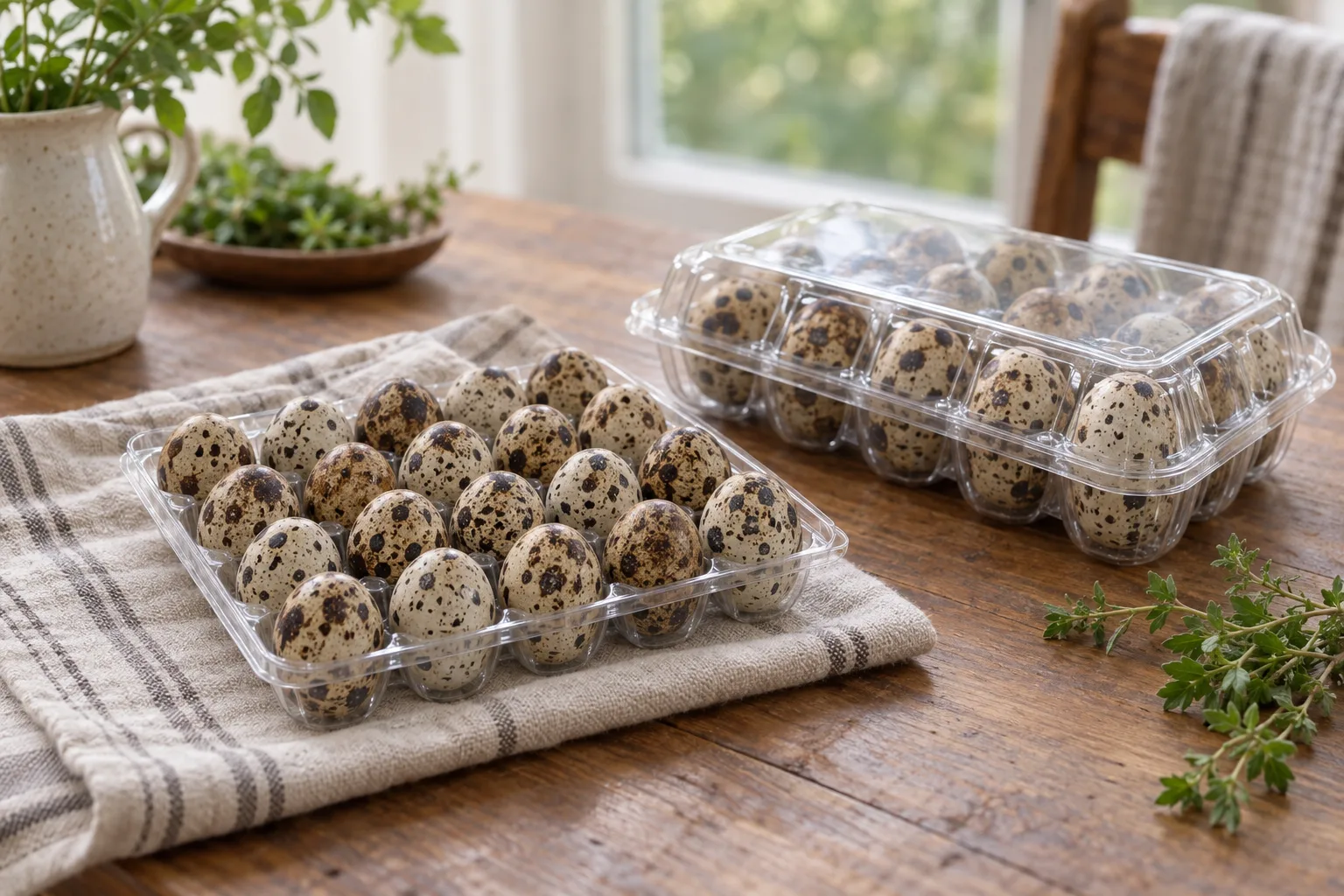
Choose an open flat for high-volume collection, a small closed carton for protected dozen-count portions, or a larger closed carton for bulk storage and display. The 90-egg Rite Farm flat is a staging tool. The LayHyand 12-count and KUKLIPJIM 30-count cartons add lids, defined portions, and easier handling.
| Tray type | Typical capacity here | Best use | Main trade-off |
|---|---|---|---|
| Open flat | 90 eggs | Collection and staging | No lid or individual closed package |
| 12-count closed carton | 12 eggs | Selling, carrying, and household storage | More cartons for a large flock |
| 30-count closed carton | 30 eggs | Bulk storage and display | Larger unit to label and place |
Open flats for collection and staging
An open flat earns its keep when you gather many eggs, sort them, or move them briefly from the coop to a work surface. The Rite Farm 90-Egg Quail Flat holds 90 quail-size eggs per tray, uses heavy-duty poly, and is listed as washable, stackable, and nestable. Its 12.375 x 12.375 x 1.25 inch footprint is useful to know before you plan shelf space.
Skip this format if you need a lid, a labeled retail unit, or protection while carrying eggs in a vehicle. An open flat is excellent at holding a batch in place. It does not replace a closed carton.
12-count closed cartons for everyday handling
A 12-count carton is the sensible default for a small backyard flock. LayHyand's listing describes a PVC clamshell with a snap lock, reusable construction, and space for 12 small or standard quail eggs. The listed dimensions are 5.4 x 3.9 x 1.4 inches, so compare them with your shelf and carrier before ordering a large pack.
This format gives you a lid, a natural dozen-count label, and a compact package for selling or transporting. It also limits the loss if one carton is dropped. The fit statement excludes chicken, duck, goose, and jumbo eggs, so check your actual eggs rather than shopping by the word “egg” alone.
30-count cartons for bulk storage and display
A 30-count carton suits a keeper who wants fewer packages for a larger batch. KUKLIPJIM's listing describes a snap-lock PVC carton that holds 30 quail eggs and stacks for bulk storage, display, or a produce stand. Its listed dimensions are 6.5 x 1.4 x 7.9 inches, but confirm how that orientation matches your shelf.
This is a capacity choice, not automatically a better choice. A 30-count carton takes more eggs to fill and can be less convenient when customers want a dozen. Choose it when batch handling and display matter more than small portions.
What should you check before buying a quail egg tray?
Check cell fit and outside dimensions first, then decide how much protection, labeling, and stacking you need. A tray can hold the right number of eggs and still fail your setup if the cells are loose, the lid hits a shelf, or the footprint does not fit your carrier.
Cell fit matters more than the headline capacity
Quail eggs vary, and a capacity number does not tell you how snugly each egg sits. Look for a listing that names quail-size eggs or gives a clear fit statement. Avoid assuming a chicken egg carton will work. Cells that are too loose let eggs shift, while cells that are too tight make loading awkward and can put pressure on shells.
If you keep more than one type or line of quail, check the fit against the larger eggs in your collection. A tray should serve your real batch, not an average egg that exists only in the product description.
Capacity should match your collection rhythm
Choose capacity by what you handle at one time. A 12-count carton works when you sell or store in dozen-sized groups. A 30-count carton reduces package count for bulk batches. A 90-egg open flat gives you room to collect and sort, yet its open design leaves the eggs exposed to the handling around it.
Think about full and partly full trays. A small keeper may find a half-empty 30-count carton less useful than two 12-count cartons, especially when labeling or giving eggs away. A large flock may prefer one open flat for gathering, followed by closed cartons for anything leaving the work area.
Lids and protection decide where the tray can go
A lid keeps eggs together when you carry, stack, or move them. A snap-lock or clamshell closure also creates a clear boundary around the batch. Open flats are easier to load and inspect, but they need a stable shelf and careful handling.
Do not treat a lid as proof of shipping performance or a food-safety outcome. It simply gives the eggs more physical protection than an open surface. Keep the tray clean, follow the listing instructions, and handle eggs in a way that fits your local food rules.
Labels, stacking, and dimensions are daily-use features
Closed cartons are easier to label by count, collection date, or destination. Before buying, check whether the lid leaves a flat area for your label and whether stacked cartons stay stable. For open flats, check shelf width and nesting height, especially if you plan to stage several trays.
Measure the refrigerator shelf, pantry, carrier opening, or display space. Product dimensions describe the tray, not your equipment. Capacity does not prove that it fits a refrigerator shelf, carrier, incubator, or turning mechanism.
Which price tier makes sense for a quail egg tray?
The budget tier should follow your handling job. A $ option can cover basic closed cartons for a small seller, $$ makes sense for larger packs or heavier reusable formats, and $$$ is only useful when the extra capacity or construction solves a real storage problem.
| Price band | What you usually get | Best fit |
|---|---|---|
| $ | Basic closed cartons in a smaller or medium pack | Small flocks, first purchase, dozen-count selling |
| $$ | Larger packs, bulk capacity, or a reusable open flat | Regular collection, repeated storage, and produce displays |
| $$$ | Specialized capacity or construction | Only when the dimensions and workflow justify it |
Pack size changes the real value. A large carton pack is sensible when you sell often, while a small pack prevents a new keeper from storing more empty cartons than eggs. Compare the space needed for unused trays as carefully as the space needed for filled ones.
What mistakes do keepers make when choosing a tray?
The common errors are easy to avoid: buying by cell count alone, ignoring the lid, and treating a storage carton like hatching equipment. Match the tray to the next job the eggs will do, then verify dimensions and fit before ordering.
- Choosing the biggest capacity automatically. A 90-egg flat is useful for staging, yet a dozen-count carton is easier to label, carry, and sell. Buy for your batch size and destination.
- Skipping outside measurements. A tray that holds the eggs can still fail to fit your shelf or carrier. Compare every listed dimension with the space you measured.
- Expecting an open flat to protect eggs like a carton. Use the flat in the collection area and move eggs into a lidded format for storage or transport.
- Buying a pack that is too large. Pack economics only help when you will use the cartons. Count your normal weekly handling needs and storage space for empty cartons.
- Using a storage tray in an incubator without checking. Setter trays and storage cartons have different jobs. Confirm the incubator maker's dimensions, cell layout, and turning requirements.
Which quail egg trays are worth considering?
For specific recommendations, start with the full comparison of open flats, lidded cartons, capacity, protection, and value in Best Quail Egg Trays (2026): 7 Storage Picks. The short version is simple: use Rite Farm for high-volume staging, LayHyand for 12-count handling, and KUKLIPJIM when a 30-count closed carton suits your batch.
- Rite Farm 90-Egg Quail Flat: the high-capacity collection option, with a washable heavy-duty poly flat that stacks and nests.
- LayHyand 12-count carton: the practical closed format for selling, carrying, and ordinary small-flock storage.
- KUKLIPJIM 30-count carton: the bulk format for storage and display when 30 eggs per carton is useful.
Is a storage tray the same as an incubator setter tray?
Storage trays and incubator setter trays do different work. A storage tray organizes collected eggs; a setter tray must match the incubator's footprint, cell arrangement, clearance, and turning mechanism. A capacity number alone cannot establish compatibility.
If you are actually setting eggs, read Best Quail Egg Incubator (2026): 5 Top Picks for a comparison of complete quail incubators. Then use Quail Egg Incubator Settings: Day-by-Day Schedule for Coturnix for temperature, humidity, turning, and lockdown guidance. For checking eggs before moving them to hatching equipment, see Best Egg Candler for Quail Eggs (2026): 7 Picks.
Follow the incubator maker's documentation for the tray that belongs inside that machine. Do not force a carton or open flat into a turning system because its egg count looks right.
Frequently asked questions
What size tray is best for quail eggs?
For most backyard keepers, a 12-count lidded carton is the easiest starting point. It suits a dozen eggs, protects them during handling, and gives you a simple unit to label. Choose a larger closed carton for bulk storage or an open flat for collection and staging.
How many quail eggs fit in a tray?
The products in this guide hold 12 eggs per closed carton, 30 eggs per closed carton, or 90 eggs per open flat. Those figures describe cell count only. Check the outside dimensions before buying, because capacity does not prove that a tray fits your refrigerator, carrier, or other equipment.
Should quail eggs go in an open flat or a carton?
Use an open flat for gathering and sorting a large batch. Use a closed carton for storage, selling, labeling, or carrying eggs. The lid and individual cells give a carton a clear advantage once the eggs leave the collection area.
Can a quail egg storage tray go in an incubator?
Do not assume it can. A storage tray and an incubator setter tray serve different jobs, and an incubator may require a specific footprint, cell arrangement, or turning system. Check the incubator maker documentation before placing eggs in any tray.
Are quail egg cartons reusable?
Some listings describe their PVC cartons as reusable, including the LayHyand 12-count carton. Reuse only when the carton remains intact and can be cleaned carefully. Keep hygiene practical, and follow the product instructions rather than assuming every plastic tray handles the same cleaning method.
What should I measure before buying a quail egg tray?
Measure the space where the tray will live, then compare it with the listing dimensions. Also check the egg fit, lid clearance, stack height, carrier opening, and any equipment interface. Cell count answers only one part of the buying question.