 Quail Corner

How to Store Quail Eggs in Trays: 6 Steps
To store quail eggs in trays, sort the collection first, choose an open flat or lidded tray for the job, load each cell gently, then label and stack it where it will stay steady. This keeps batches out of one loose bowl and makes the next move much easier.
How to Store Quail Eggs in Trays
A repeatable six-step keeper workflow
Step 1 Sort the collection
- Set aside cracked or dirty eggs
- Keep batches together
Step 2 Choose the tray
- Use an open flat for staging
- Use a lidded tray for moving eggs
Step 3 Load and label
- Seat each egg gently
- Mark the collection date and batch
Step 4 Stack and clean
- Keep stacks stable
- Clean the empty tray
Result
Eggs are separated by batch, protected for their next move, and easy to find.
Quick answer
Use an open high-capacity flat for collection and staging. Use a lidded compartment tray for storage, selling, or transport. Keep cracked or questionable eggs out of the clean batch, label the tray before stacking, and follow the current FDA egg-safety guidance for official handling and storage advice.
For compact household storage, the KGFKTYU 18-Count Stackable Tray holds 18 quail eggs and measures 7 x 3.5 x 1.5 inches. The brown reusable tray is intended for refrigerator, counter, pantry, and food-preparation storage, and the listing describes it as easy to clean. See the current KGFKTYU listing. Skip it if you need a high-volume open collection flat, a clearly lidded sales carton, or a tray confirmed for a particular incubator.
What you'll need
- An open flat for collection, or a lidded compartment tray for storage and transport
- Removable labels and a pencil or marker
- A clean cloth and a place where the loaded tray will not be bumped
If you are handling fertile eggs, make a separate batch before you load anything. Mississippi State University Extension explains hatching-egg care in its pages on reproduction and incubation and washing hatching eggs. Keep that workflow separate from ordinary eating-egg storage.
Our Top Picks
Step-by-step
Step 1: Sort the eggs before loading
Start with the collection on a clean surface. Separate cracked eggs, eggs with heavy contamination, and intact eggs. Keep eggs from different collection rounds or groups in their own piles so one label can describe the whole tray.
Follow the FDA page linked above for official food-storage guidance. A keeper’s tray routine cannot turn a damaged shell into a sound one.
Step 2: Pick an open flat or closed tray
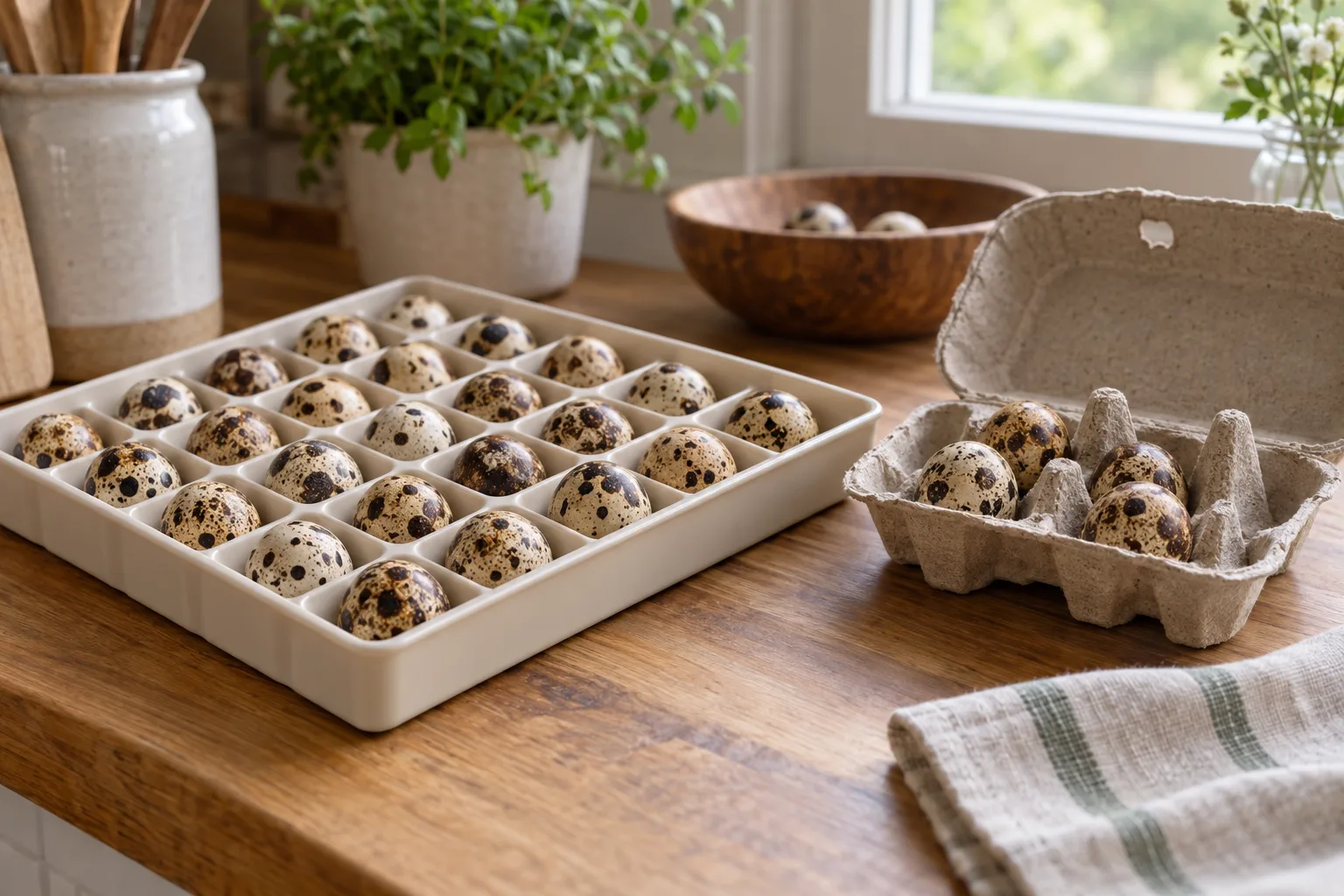
Choose an open flat when you are gathering a large number of eggs and need to see or count them quickly. It is efficient for staging, though exposed cells give little protection once you carry the tray.
Choose a lidded compartment tray for a refrigerator, a sale, or a trip. The lid keeps the cells together and gives you a better surface for a batch label. The full comparison in best quail egg trays (2026): 7 storage picks covers capacities, protection, stacking, and use cases.
Step 3: Load each cell gently
Place one egg into each matching cell rather than dropping a handful into the tray. Make sure each egg sits below the rim and that the lid, if present, closes without touching the shells. If a cell is too tight, use a different tray instead of forcing the egg down.
Keep the pointed-end orientation consistent if that helps you inspect the batch later, but do not squeeze eggs into a fixed position. The cell should support the egg without pressure.
Step 4: Label the batch
Label the tray before you stack it. Write the collection date, flock or pen if you keep more than one group, and whether the eggs are for household use, sale, or hatching. A removable label on the lid or tray edge is easier to update than writing across a reusable compartment.
Use one tray for one clear batch whenever possible. Mixing old and new eggs in one unlabeled flat is how the back row gets forgotten.
Step 5: Stack and move it safely
Put the heaviest stable tray at the bottom and keep the stack low enough that it cannot sway when you reach into the refrigerator or pantry. Closed cartons are the better choice for carrying eggs to a customer or another room. Hold an open flat level with both hands and avoid setting anything on top.
Step 6: Empty, clean, and reset the tray
When a tray is empty, remove the label and any shell debris before it returns to the shelf. Follow the maker’s cleaning directions, use a clean cloth for the surface, and let the tray dry before loading the next batch.
The KGFKTYU tray is a sensible compact pick for repeated household storage because it holds 18 eggs and is described as easy to clean. It is a poor fit for bulk collection or a sale carton because its capacity is limited and the listing does not state that it has a lid.
Common mistakes
- Using an open flat for transport: The cells are exposed, so choose a lidded carton when the tray will be carried.
- Mixing batches: A single label becomes unclear when collection dates or intended uses are different.
- Confusing storage with incubation: A storage tray is not automatically compatible with a setter, turner, airflow path, or incubator shelf.
Troubleshooting
The eggs rock or sit loosely in the cells
The tray cells are too large for that batch, or the tray is designed for a different egg size. Move the eggs to a closer-fitting quail tray. Do not pad cells with loose material that can shed onto shells or make cleaning harder.
The stack shifts when you move it
The base is uneven, the trays are not made to nest, or the stack is too tall. Lower the stack, put it on a level shelf, and use a lidded tray for the move. Split one large batch into two stable loads if needed.
You are ready to hatch some of the eggs
Stop treating those eggs as an ordinary storage batch. For a candler suited to small mottled shells, see Best Egg Candler for Quail Eggs (2026): 7 Picks. Then use Quail Egg Incubator Settings: Day-by-Day Schedule for Coturnix for the temperature, humidity, turning, and lockdown reference.
Frequently asked questions
How do you load quail eggs into a storage tray?
Load clean, intact eggs one at a time into cells that match their size. Seat each egg gently, keep the batch together, and check that a lid or stack cannot press on the shells before moving the tray.
Should quail eggs be stored in an open flat or a lidded tray?
Use an open flat for collection and short staging when you need capacity and quick access. Choose a lidded tray for storage, selling, or transport because the cover protects cells and makes the batch easier to carry.
Can a quail egg storage tray go in an incubator?
Assume it cannot unless the incubator maker confirms the fit and function. Storage trays hold collected eggs, while setter and turner trays are made for airflow, turning, and the incubator housing.
How should quail egg trays be labeled and cleaned?
Write the collection date, flock or batch, and intended use on a removable label or the carton. Empty the tray first, follow the maker’s cleaning directions, and let it dry fully before reloading it.