 Quail Corner
How Many Quail per Cage? (2026 Stocking Guide)
Work out how many quail fit by measuring the usable floor and dividing by your bird's space needs: 1 sq ft per bird on wire, 1.5 sq ft if you want it kinder, 2 sq ft in a ground pen. Then match your flock to our quail cage picks, because the cage you buy sets the flock you can keep.
"How many per cage" is really "how many per square foot," and cage listings rarely do that math for you. A vendor says a section holds 5 small quail; keepers on Backyard Chickens say 1 sq ft per bird and no tighter. This guide gives you a method, and the sex-ratio math that sets the real ceiling.
What kind of cage changes the count?
The housing type sets the divisor before you count anything. Wire breeder cages run at 1 sq ft per bird minimum, ground pens want 2 sq ft per bird, and grow-out pens follow the wire rule for chicks moving through. Here is the whole picture in one table.
| Housing type | Floor rule | Height | Who it suits |
|---|---|---|---|
| Wire cage (stacked breeder) | 1 sq ft per bird minimum, 1.5 kinder | 8 to 12 in | Egg flocks, garages, easy cleaning |
| Ground pen / aviary | 2 sq ft per bird or more | Taller with a soft roof | Outdoor keepers who want room to scratch |
| Grow-out pen | Wire rules, sized to the chicks | 9.5 in levels, roughly | Brooder-to-butcher batches |
| Button quail setup | Floor space over height | Low, with a soft roof | Pairs or one male with 2 to 3 hens |
Wire breeder cages
Sectioned plastic or wire stackers are the default for backyard egg flocks. The 1 sq ft rule comes from extension poultry guidance, and keepers on Backyard Chickens who tried ¾ or ½ sq ft per bird report it works until it suddenly doesn't. Heights sit at 8 to 12 inches on purpose, low enough that a startled bird can't build speed and hit its head. Stack a second layer and the count doubles on the same footprint: Hatching Time's 3-section 2-layer carries six sections and runs roughly 15 to 30 birds at the minimum.
Ground pens and aviaries
A pen on grass or bedding needs 2 sq ft per bird or more. Ground gets fouled fast, and birds on it scratch, dust-bathe and behave like quail, so the same footprint holds half as many birds as a wire stacker. That rule is why a wooden ground pen like the Kecreque A-frame, roughly 47 by 18 inches of floor, is a 3 to 5 bird home and never a flock pen. Our housing guides cover predator-proofing and roofing in depth.
Grow-out pens
Grow-out pens sit between the brooder and the laying cage. Chicks move over at 3 to 4 weeks, fully feathered, and they grow fast, so plan that pen before you ever set eggs. Map the timeline with the hatching guides, then count the floor for the young flock separately from your layers.
What actually sets the right density?
Three numbers set your count: floor area per bird, sex ratio, and bird size. Nothing else moves the number as much, so settle those before you order anything.
Stocking rate
The rule is clean and works on any cage you own or plan to buy: measure usable floor in inches, divide by 144 to get square feet, then divide by your stocking rate. A 24 by 24 inch section is 4 sq ft, so 4 wire-kept birds at 1 sq ft each, or 2 birds in a ground pen at 2 sq ft each.
Buy for the minimum number, not the brochure number. A vendor's "up to 6 large or 10 small" is the tight end of the range, and most keepers run at the comfortable mid-point. When in doubt about a floor plan, round down.
Feed and water scale with the count too. An adult eats about 1 oz (25 to 30 g) of crumble a day, so every 16 birds you add means another pound a day going into the cage. Our feed and water guides cover feeders and waterers that keep up.
Sex ratio
If you want chicks, you need a male, and the ratio matters: one male per 4 to 5 hens, and never leaner than one male to 3. Too many males means fights, feather loss, and hens that never rest. For layers only, skip the male entirely and keep a tidy flock of hens.
Bird size
A standard coturnix is one thing, a jumbo another. Larger birds take more space, so the same 24 inch section that fits 4 standards fits 2 to 3 jumbos. If you plan to raise big birds for meat or eggs, use the 1.5 sq ft end of the range, not the tight minimum.
What does each budget buy in bird count?
Price tracks floor and equipment, so a cheap cage usually holds fewer birds and a bigger one more. Spend on total usable area first, then the trays and water that keep them clean. This table shows what each price range usually buys.
| Budget | Typical bird count | What you get |
|---|---|---|
| Under $50 | 1 to 3 birds | A single-section starter or small hutch, enough for a pair or a trio |
| $50 to $150 | 3 to 6 birds | A 2-section wire cage with trays and a water tank, a solid first step |
| $150 to $300 | 6 to 15 birds | A 3-section unit or small breeder stack with roll-out trays |
| $300+ | 15 to 30 birds | A multi-layer stacked system for a proper laying or meat flock |
Spend to the bird count you actually want. A $40 wire cage keeps 3 quail happy; a $400 six-section stack can run 20. Stay above the per-bird floor rules and the money buys area and trays, and the birds stay calm.
Which stocking mistakes could hurt the flock?
A few recurring errors cause most overcrowding and feather-loss. Avoid these and your count stays right.
- Guessing instead of measuring. "Looks fine" is how a 4 ft² section ends up holding six quail. Always measure the usable floor and divide.
- Following the vendor's maximum. "Up to X birds" is the absolute ceiling in a perfect setup, not a comfortable day one. Use the per-bird rules above instead.
- Running too many males. Extra males mean fights and stress. Stick to the 1:4 or 1:5 ratio, or skip males and keep all hens.
- Mixing sizes without changing the count. A jumbo and a standard are different birds; don't crowd jumbos to standard density.
- Trusting the footprint over the floor. A cage's outside dimensions aren't what the birds stand on; trays, walls and roll-out slopes eat into the usable area. Measure the wire the birds actually stand on.
Our picks
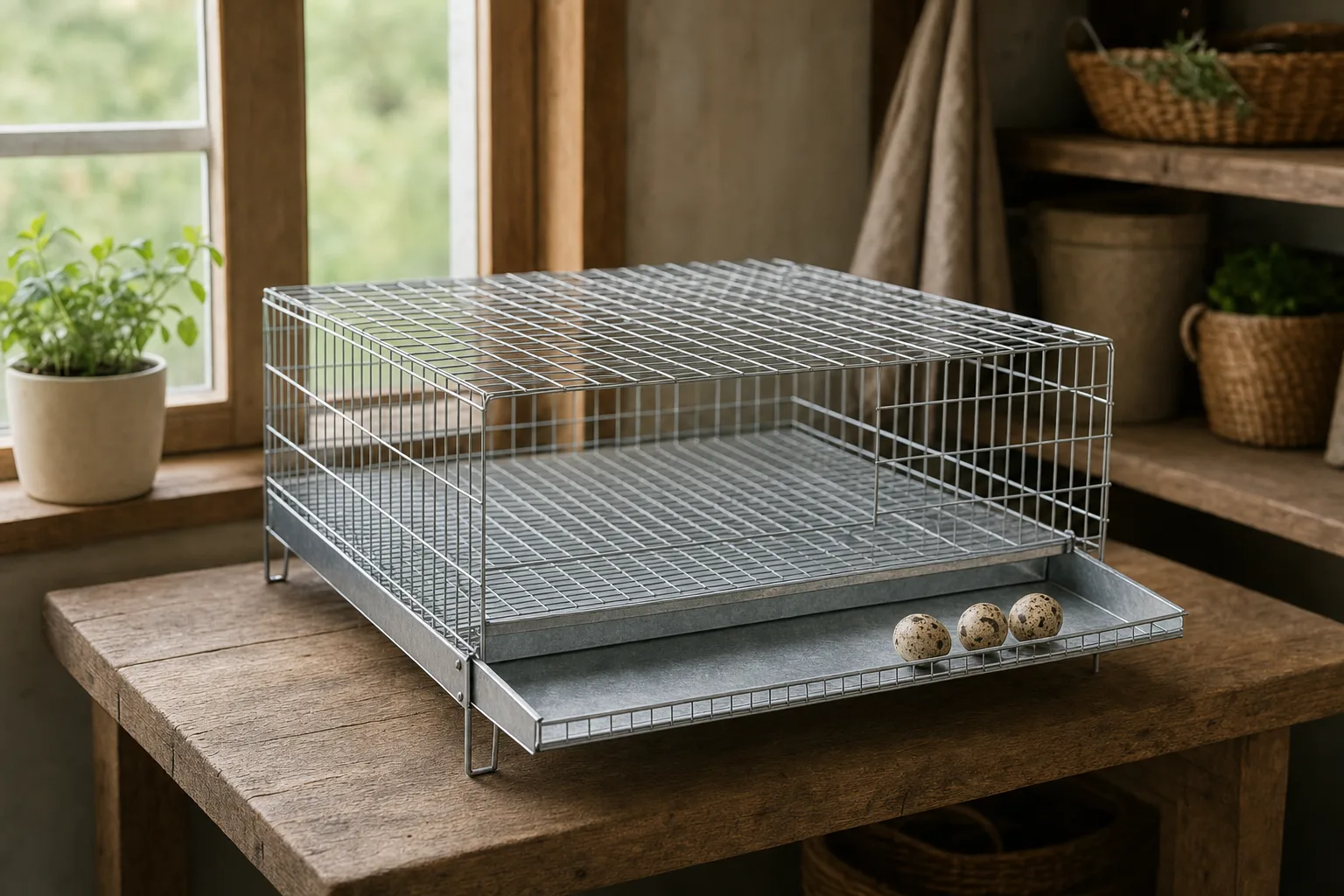
Once you know your bird count, the next step is picking a cage that fits both the floor and the budget. Rather than repeat each model here, see the full breakdown in Best Quail Cage (2026): 6 Verified Picks for Every Flock. Two examples from that roundup show the math: the Hatching Time 2-Section 1-Layer is the starter flock made real, two sections the vendor rates at up to 6 large or 10 small, and the 3-Section 2-Layer is the 15 to 30 bird machine.
Frequently asked questions
How many quail can you keep per cage?
Count the usable floor and divide: 1 sq ft per bird minimum on wire, 1.5 sq ft if you want it kinder, 2 sq ft per bird in a ground pen. A six-section stacked breeder cage runs roughly 15 to 30 birds at the minimum. The sex ratio, one male per 4 to 5 hens, sets the real limit once you add a male.
How many square feet does a quail need?
One square foot (0.09 m²) per bird is the wire-cage minimum, 1.5 sq ft is kinder, and ground pens want 2 sq ft each. When your floor math lands between two numbers, round down. Keepers on Backyard Chickens report the same: squeeze past 1 sq ft and the squabbles start.
How many quail fit in a 3-section cage?
Hatching Time rates each section at 3 large or 5 small quail, their spec, so a 3-section layer runs 9 to 15 birds. The 3-section 2-layer unit stacks six sections and runs roughly 15 to 30 birds at the 1 sq ft minimum. Jumbo birds fill a section about twice as fast as standards.
How many male quail can live in one cage?
One male per 4 to 5 hens, and never leaner than one male to 3. Extra males fight, and the injuries that follow end flocks. Running eggs only? An all-hen cage needs no male at all, and it keeps the mornings quieter.
How many quail fit in a 2 by 4 foot pen?
A 24 by 48 inch pen works out to 8 sq ft, so about 8 birds at the 1 sq ft minimum or 5 to 6 at the kinder 1.5 sq ft. Settle the sex ratio first: 8 birds as one male to 7 hens works; two males in that space is asking for fights.
How many button quail per cage?
Keep buttons in pairs or one male with 2 to 3 hens. They weigh 1.5 to 2 oz as adults and want floor over height, so a long low pen suits them better than a tall one. Give them a soft or low roof, because they jump straight up when spooked.