 Quail Corner
Best Chick Brooder
Brinsea Ecoglow Safety 600 Chick or Duckling Brooder, Up to 20 Chicks
$$
Check Price on AmazonAdult Coturnix quail generally do not need a heat lamp in winter when their cage is dry and draft-free. They are fine to about 20°F / −7°C in those conditions. Supplemental heat is a situational warm-zone decision, so start with shelter and read our quail cage heater picks if your flock still needs a warmer corner.
Chicks are different. Week-one Coturnix chicks need 95°F / 35°C at chick level, with heat dropped about 5°F per week and generally off by 3–4 weeks in warm weather. This guide separates brooder equipment from adult-cage warmth, then covers placement, controls, cost, and power-loss planning.
For adult quail that genuinely need extra warmth, a radiant panel is usually the best fit. A brooder plate belongs mainly with chicks, while a ceramic emitter is a bulb component that needs a compatible fixture and guard. Any powered option needs dry placement, protected cords, visual checks, and an outage plan. It should warm one area, not the whole enclosure.
| Type | Best use | Main check |
|---|---|---|
| Radiant panel | Localized adult-cage warmth | Stable placement and a cooler retreat |
| Brooder plate | Chick brooding | Chicks can move under it and away |
| Ceramic emitter | A keeper-supplied component setup | Rated fixture, guard, clearance, and cord safety |
A panel warms a localized area by radiant heat, which suits an adult cage better than trying to heat every pocket of enclosure air. Mount or place it securely. Leave room for birds to move away, and keep it clear of bedding, splashes, feed, water, and egg collection. The SWEETER HEATER panel review is a useful next read for this format.
Chicks move under a plate for warmth and step away when they need a break. Use 95°F / 35°C at chick level in week one, then reduce about 5°F per week. Place feed and water safely outside the warmest area. For another chick-focused view, see our quail brooder picks.
The bulb alone is not a complete cage heater. A complete setup needs a compatible fixture, a guard, safe clearance, protected cord routing, dry placement, and your own fire-safety plan. That list makes an emitter a poor default for unattended quail housing, especially during a power outage.
Match a radiant panel to adult supplemental warmth and a plate to brooding. Chick capacity does not describe adult coverage. Button quail differ from Coturnix, especially in their tiny size and indoor needs, so this page stays focused on adult Coturnix and Coturnix chicks.
At the chick-equipment point, the Brinsea Ecoglow Safety 600 Chick or Duckling Brooder, Up to 20 Chicks is a useful catalog example. Its verified details include 12 watts, 12 volts, radiant heating, indoor use, up to 20 newborn chicks or 12 older chicks, four adjustable legs, a maximum setting of 113°F, a 10-foot cord, and a 3-year manufacturer warranty. It is chick equipment, not adult-cage equipment. Check the Brinsea Ecoglow Safety 600
$$
Check Price on AmazonPlace our quail brooder sizing guide beside the product listing so you size the run to the chick count. The plate still needs a suitable brooder, safe cord routing, and regular checks.
Record only the listed power, controls, dimensions, mounting method, warranty, indoor or outdoor wording, and cleaning instructions. Product copy describes the device. It does not prove that Quail Corner tested it on quail or establish a universal adult-cage setting.
Choose a stable mount or stand, keep the device away from litter and splashes, and route the cord where birds cannot reach or foul it. These steps reduce risk. They do not guarantee fire prevention or safe operation in every cage.
Provide a warm area and a cooler retreat rather than uniform heat. Keep feed, water, airflow, and egg collection accessible. Never seal the cage into a hot box. Heat stress occurs above about 90°F / 32°C, so a bird's ability to leave the warm area matters.
No. A control cannot replace safe mounting, dry placement, protected cords, visual checks, or an outage plan. Do not assume a thermostat unless the product listing states one. A separate timer handles light rather than heat, because Coturnix need 14–16 hours of daylight to keep laying.
Balance the price with listed power, controls, warranty, review volume, and setup complexity. For an emitter, add the cost of its matching fixture and guard. Review coverage is a confidence factor, not a safety verdict.
Give each adult Coturnix at least 1 ft² / 0.09 m² of wire-cage floor. A kinder target is 1.5 ft² per bird. Keep cage height at 8–12 in / 20–30 cm; a taller enclosure needs a soft roof because startled birds can hit their heads. These figures do not determine heater power.
Your budget changes how much setup work you supply. Every tier still needs dry placement and a cooler escape, and a bare emitter never qualifies as a complete system.
Use the heater roundup for product-by-product comparisons and the brooder pages for chick sizing. Keep adult cage warmth separate from chick equipment.
For housing context, read Poultry Extension's Japanese quail guide and Project Upland's Keeping Quail in the Winter. Modern Survival Blog's radiant-heat guide adds useful heater safety context. These are reading sources, not product tests.
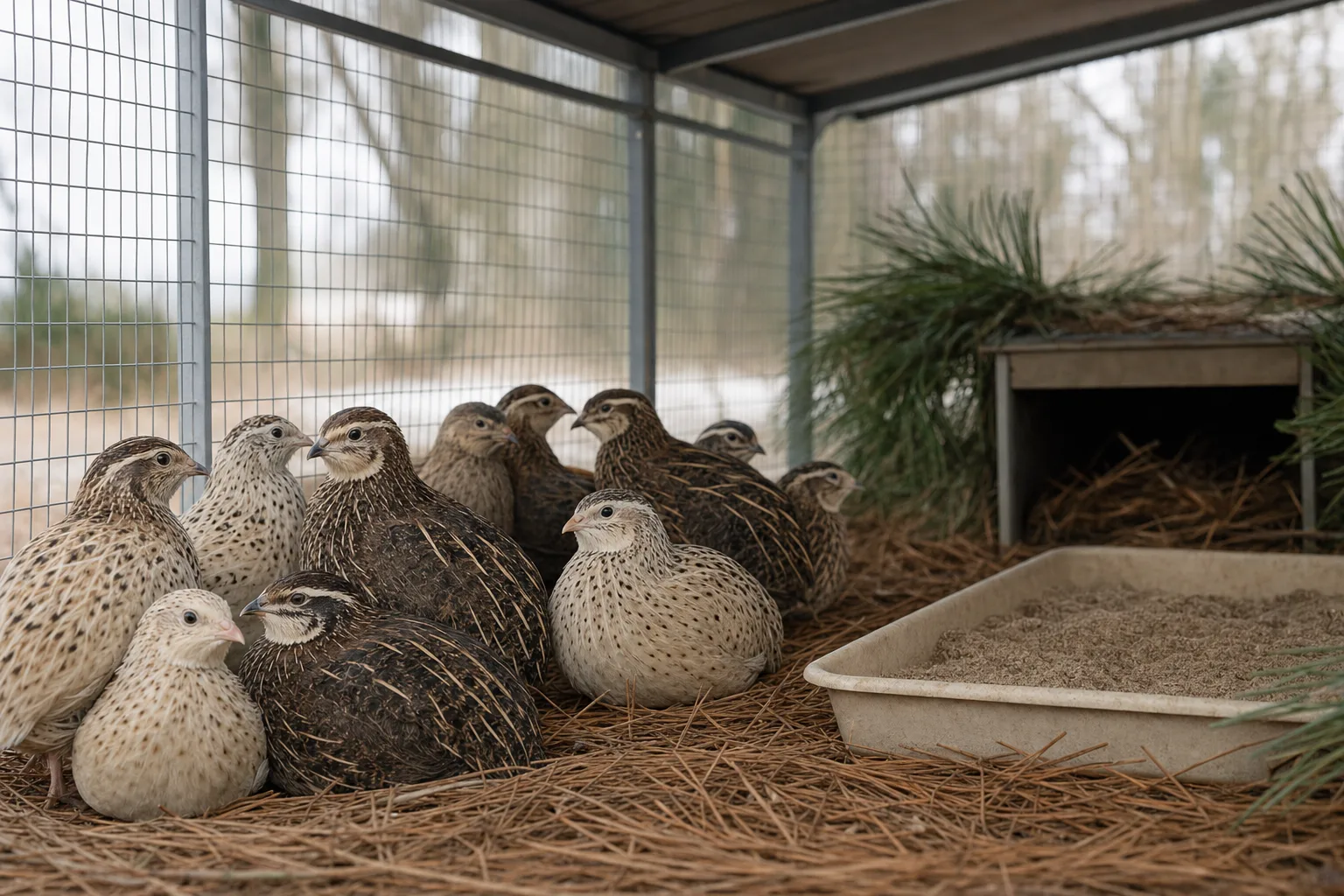
Adult Coturnix generally need no added heat when their housing stays dry and draft-free. They are fine to about 20°F / −7°C in those conditions, though that is a tolerance guide rather than a promise or an adult target temperature. Improve shelter first, then consider a warm retreat for a specific reason.
Outdoor birds need a dry shelter, moving air without a direct draft, and a place to move away from any supplemental warmth. Local weather, moisture, cage position, and power reliability all matter. Keep ventilation open and make a warm retreat an optional aid rather than turning the whole cage into a heated box.
No single format fits every flock. A radiant panel is usually the more practical adult-cage format because it can warm one area without relying on an exposed bulb. A lamp or ceramic emitter adds fixture, guard, clearance, cord, and monitoring requirements. No format removes the need for safe mounting and visual checks.
There is no universal wattage or bird-to-heater ratio for an adult quail cage. Choose by the complete setup, the listed product details, safe placement, and the ability to provide a cooler retreat. Never select the highest wattage as a shortcut, and do not use an unguarded lamp as an unattended default.
Coturnix chicks need 95°F / 35°C at chick level in week 1, then drop the heat about 5°F per week. Heat is generally off by 3–4 weeks in warm weather. A brooder plate can provide the warm underside area, so a lamp is one option rather than a requirement for every chick batch.
Heat and laying light solve different problems. Coturnix need 14–16 hours of daylight to keep laying, with a timer used to supplement short autumn and winter days. A heater does not replace that light routine, and extra heat should never be used to maintain laying months on its own.