 Quail Corner

Best Stackable Quail Cage (2026): 6 Space-Saving Picks
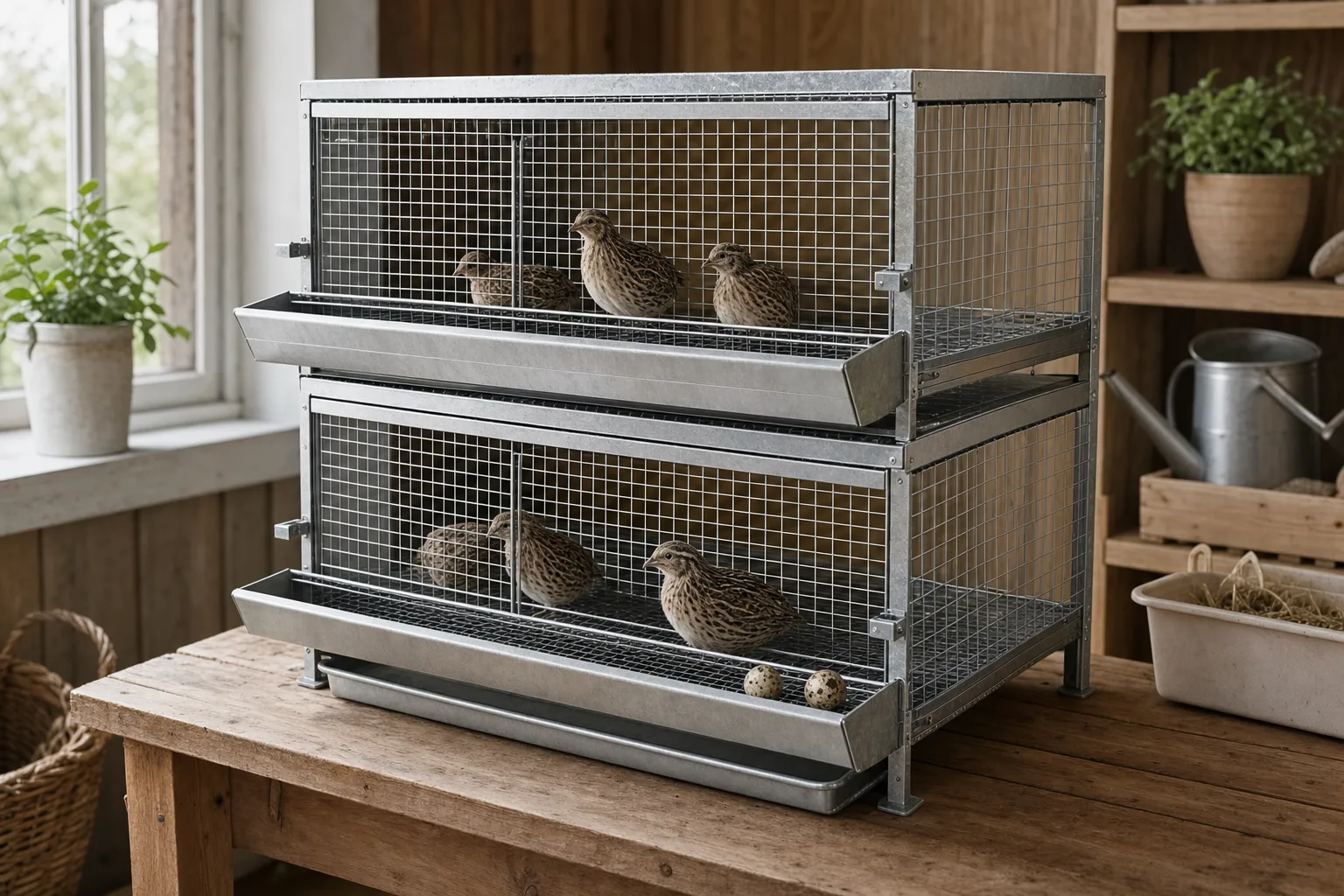
The best stackable quail cage for most backyard keepers is the Hatching Time 3-Section 2-Layer Breeding Cage. It gives you six configurable sections, useful trays, and watering in a complete vertical system for the $$$ price band. Choose it when you can reach both tiers and still leave room to pull the trays clear.
Stacking saves floor footprint, not bird-space math. This roundup compares the listing details, section layout, floor choice, egg collection, tray access, and watering so you can choose a cage that fits your flock and your daily routine.
Our top stackable cage picks
Ranked by usable floor space, section layout, cleanup, egg collection, and watering access
Overall
The complete vertical system
- Six configurable sections
- Traditional flooring
- Roll-out egg collection
- Gravity-fed watering
Top Pick Hatching Time 3-Section 2-Layer Breeding Cage
$$$
Best for a growing indoor flock
Check Price on Amazon Budget
A sensible first cage
- One section
- Traditional flooring
- Removable waste tray
- Gravity-fed watering
Top Pick Hatching Time 1-Section 1-Layer Breeding Cage
$
Best for a small standard-size flock
Check Price on Amazon Compact
Jumbo space in a short footprint
- One section
- Jumbo flooring
- Roll-out egg collection
- Compact 11.8-inch width
Top Pick Hatching Time 1-Section 1-Layer Jumbo Cage
$
Best for a few larger Coturnix
Check Price on AmazonQuick answer: Choose Hatching Time 3-Section 2-Layer Breeding Cage for the strongest all-around setup with standard Coturnix, provided you plan birds by usable floor area. Jumbo lines are better served by the three-section Jumbo model, with its matching Jumbo layer added when you want a second tier. Choose the one-layer Traditional model for a budget or small-flock start, and the one-section Jumbo model when you need a compact cage for larger Coturnix.
Top pick specs: six configurable sections, Traditional flooring for regular-size quail, roll-out egg collection, removable waste trays, gravity-fed watering, 38.6 x 24 x 35.8 inches assembled, and a listing claim of up to 30 standard quail. That last figure is the product listing's claim, not a welfare recommendation. Each layer measures 35.8 x 17.3 inches before dividers, so use the usable area in each section for your bird count.
Quick picks
Our Top Picks


Comparison table
| Product | Best for | Price band | Key spec | Verdict |
|---|---|---|---|---|
| Hatching Time 3-Section 2-Layer Breeding Cage | Growing flocks that want a complete, vertical six-section system | $$$ | 3 sections per layer; 6 configurable sections; 38.6 x 24 x 35.8 in assembled | Best overall |
| Hatching Time 3-Section 1-Layer Jumbo Cage | Larger Coturnix keepers who want three sections without committing to two tiers | $$$ | 3 sections; 38.6 x 24 x 23 in assembled | Best Jumbo Single Tier |
| Hatching Time 2-Section 1-Layer Breeding Cage | Small breeding groups that need two separated sections and integrated watering | $$ | 2 sections with removable middle wall; 23.8 x 24 x 18.1 in assembled | Best Divided Setup |
| Hatching Time 1-Section 1-Layer Breeding Cage | First-time keepers and small standard-size flocks on a tighter budget | $ | 1 section; 11.8 x 24 x 18.1 in assembled | Budget Pick |
| Hatching Time 1-Section 1-Layer Jumbo Cage | A small flock of larger Coturnix that needs jumbo flooring in a compact footprint | $ | 1 section; 11.8 x 24 x 18.1 in assembled | Best Compact Jumbo |
| Hatching Time 3-Layer Grow-Out Pen, 15-Inch | Large indoor grow-out setups that prioritize deep trays and integrated water delivery | $$$ | 3 sections per layer in a stackable tier design; 38.6 x 25.2 x 68.1 in | Best for Grow-Out |
How we evaluate
Usable floor area comes first. Coturnix need at least 1 square foot, or 0.09 square metres, per bird in a wire cage, and 1.5 square feet is kinder. A tall stack can look impressive while leaving each section too small, so divide the actual floor area by the birds you plan to keep rather than trusting a headline capacity.
We also look for a safe low profile, a usable egg roll-out, removable manure trays, reachable feeder and water-line connections, and enough room to pull trays clear. The housing guidance for a Coturnix section is 8 to 12 inches, or 20 to 30 centimetres. Taller bird spaces need a soft roof because startled birds can hit their heads. An assembled stack's outside height does not tell you the height of each bird compartment, so check the listing carefully.
Finally, we separate a complete cage from a grow-out or add-on style purchase. Penn State Extension, Mississippi State University Extension, and Texas A&M AgriLife poultry guidance inform the husbandry context. Product-specific capacities and accessories come from the verified listings, and a vendor number is never a stocking recommendation.
Individual product reviews
1) Hatching Time 3-Section 2-Layer Breeding Cage: Best Overall
This is the pick for a keeper who wants the vertical layout to do real work. Three sections per layer give you six configurable spaces, while the 35.8 by 17.3 inch floor on each layer gives you a clear starting point for floor-space math. This is the Traditional flooring version, which Hatching Time positions for regular-size quail, so jumbo lines belong in the next pick. The label still does not answer the floor-wire question. Check the actual opening size before you commit your birds to it.
The useful part is that the system arrives with more than a frame: roll-out egg collection, removable extended waste trays, and gravity-fed watering for both layers. Its 38.6 by 24 by 35.8 inch assembled size is manageable for an indoor room or enclosed shelter. The limitation is access. Two layers mean you need a stable placement spot and enough clearance to remove trays without bumping the stack.
Pros
- ✓ Six configurable sections
- ✓ Traditional floor for standard Coturnix
- ✓ Trays and watering are included
Cons
- ✗ Upper tier needs thoughtful placement
- ✗ Listing capacity is not a welfare recommendation
2) Hatching Time 3-Section 1-Layer Jumbo Cage: Best Jumbo Single Tier
This one-layer version switches to Jumbo flooring and keeps the three-section layout without asking you to manage a second tier. It is a good middle ground for larger Coturnix keepers who want separated groups or breeding spaces and have enough horizontal room for the 38.6 by 24 inch assembled footprint. If you later want a second tier, Hatching Time sells a matching Jumbo add-on layer that stacks on top.
The listing specifies 7/8 x 5/8 inch floor openings, so compare that detail with the 1/2 x 1/2 inch adult wire-floor guidance before ordering. The sloped floor rolls eggs toward collection, and the extended removable waste tray keeps the service area outside the bird space. Gravity-fed watering is included. It also remains an indoor or enclosed-shelter cage, not a predator barrier.
Pros
- ✓ Jumbo flooring
- ✓ Three sections in one accessible tier
- ✓ Roll-out eggs and removable tray
Cons
- ✗ Uses more floor space than a two-layer setup
- ✗ No predator protection
3) Hatching Time 2-Section 1-Layer Breeding Cage: Best Divided Setup
The two-section Traditional cage makes sense when separation matters more than maximum vertical storage. Its removable middle wall lets the space change with your flock, and two doors make it easier to reach each side. The listing claims up to 10 standard quail, with lower figures for larger birds, so use its 23.8 by 17.3 inch floor as the real decision point.
Watering is unusually complete for this size: a 1-gallon tank, drinker cups, nipple water pipes, and external hoses are listed. Eggs roll to the collection area, and the waste tray is removable. Skip it if you want jumbo flooring or a true two-level stack. This is a compact divided cage, not a capacity shortcut.
Pros
- ✓ Removable divider
- ✓ Two doors
- ✓ Several watering options included
Cons
- ✗ Traditional floor only
- ✗ One layer limits vertical savings
4) Hatching Time 1-Section 1-Layer Breeding Cage: Budget Pick

This is the sensible starting point for a few regular-size Coturnix. The single 11.8 by 17.3 inch floor is easy to inspect, and the short 18.1 inch assembled height keeps daily access straightforward. The listing claims up to 5 standard quail and recommends 3 larger birds, which gives you a useful reminder to plan around actual bird size.
You still get the features that make a cage pleasant to use: a sloped Traditional floor, roll-out egg collection, a removable waste tray, and gravity-fed watering. There is no second tier, so it cannot save as much floor footprint as the overall pick. That is its honest limitation, and for a small flock it can be a benefit because fewer tiers mean fewer awkward trays.
Pros
- ✓ Lowest price band
- ✓ Simple one-section access
- ✓ Egg roll-out and watering included
Cons
- ✗ No stackable second tier
- ✗ Traditional floor is not the jumbo option
5) Hatching Time 1-Section 1-Layer Jumbo Cage: Best Compact Jumbo
This cage shares the compact footprint of the budget model while switching to jumbo flooring. That makes it the cleaner choice for a small group of larger Coturnix when you want a little more floor tolerance without buying a wider multi-section system. The listing gives the same up-to-5 standard-quail claim and recommends 3 larger birds for the Jumbo configuration.
The roll-out floor, collection area, removable tray, and gravity-fed watering make it a complete small cage rather than a bare enclosure. Its one section is easy to reach, though it does not create vertical capacity on its own. Buy it for the floor choice and compact access, not because a short cage can hold unlimited birds. Confirm the Jumbo opening size before ordering, since the product label alone does not replace the adult floor-wire guidance.
Pros
- ✓ Compact jumbo configuration
- ✓ Easy one-section access
- ✓ Roll-out eggs and removable tray
Cons
- ✗ Only one section
- ✗ Indoor or enclosed-shelter use
6) Hatching Time 3-Layer Grow-Out Pen, 15-Inch: Best for Grow-Out

This three-layer grow-out pen is aimed at a larger indoor setup. Its 38.6 by 25.2 by 68.1 inch footprint gives you three sections per layer in a tall stack, plus deep droppings trays and a listed 5-gallon water tank with silicone hoses and three steel nipple drinkers per layer.
The smart feeder and removable trough reduce the number of loose parts around a busy grow-out setup. Comfortplast elliptical flooring is also listed. The product title gives the sections a 15-inch height, above the usual 8 to 12 inch cage guidance, so plan a soft roof and do not assume extra height is automatically better. The verified details do not state an egg roll-out system or predator-proof rating, so this is a poor choice if egg collection is your main reason for buying a stackable cage. Treat it as a grow-out tool, not a universal adult-layer cage.
Pros
- ✓ Three-layer design
- ✓ Deep droppings tray
- ✓ Large integrated water delivery
Cons
- ✗ Egg roll-out is not stated
- ✗ Tall stack needs careful placement
Frequently asked questions
What is the best stackable quail cage for a small flock?
The one-section Traditional Hatching Time cage is the easiest fit for a small standard-size flock. Its listing claims space for up to 5 standard quail, with a removable tray, roll-out collection, and gravity-fed watering. Check the floor area against your own bird count before ordering.
How much floor space does each Coturnix quail need?
Give each Coturnix at least 1 square foot, or 0.09 square metres, of wire-cage floor space. One and a half square feet is kinder. A listing capacity is a sales claim, so divide each usable section by your planned number of birds.
Is a stackable cage better than one large cage?
A stackable cage saves floor footprint and can separate groups, but every tier adds tray and access work. A single-section cage is often the smarter purchase for a small flock, especially if you have no comfortable place to reach the upper tier.
Should I choose Traditional or Jumbo flooring?
Choose the flooring that matches your Coturnix line and check the opening size before ordering. The one-layer Jumbo listing specifies 7/8 x 5/8 inch openings, while adult wire-floor guidance is 1/2 x 1/2 inch. Do not treat a Jumbo label as a welfare recommendation.
Are these stackable quail cages safe to use outdoors?
The reviewed Hatching Time breeding cages are listed for indoor or enclosed-shelter use and are not predator-proof. Put them inside a secure shed or other protected shelter. For an exposed yard setup, read our outdoor quail cage guide and the predator-proofing checklist before buying.
How steep should an egg roll-out floor be?
Aim for approximately 7 to 10 degrees. That slope lets eggs move toward the collection area while keeping the walking surface usable. A roll-out feature still needs enough clearance in front of the cage for collection and cleaning.
Related guides
- Best Quail Cage (2026): 6 Verified Picks for Every Flock, compare stackable and single-section layouts.
- Best Quail Cage With Egg Roll Out (2026): 6 Picks, focus on cleaner egg collection.
- Best Outdoor Quail Cage (2026): 7 Weather-Ready Picks, plan a sheltered yard setup.
- How to Predator Proof a Quail Cage: 7 Steps, secure the placement area.