 Quail Corner
Best budget pick
Hatching Time Quail Breeding Cage Indoor, 1 Section, 1 Layer, Traditional
$
Check Price on AmazonThe best quail cage with egg roll out for most small backyard flocks is the Hatching Time two-section traditional system. It gives you a genuine external egg path, adjustable sections, and a washable plastic body without the footprint of a large stacked setup.
The one-section model is the cheaper compact choice. Larger keepers can move to the three-section or two-layer additions, while the jumbo model gives larger quail a floor made for their size. This roundup stays focused on ready-made cages, including the choice between a purpose-built roll-out floor and a separate retrofit.
Ranked by egg access, usable floor area, cleaning, safety, and room to expand
The easiest starting point for most small flocks
$$
A useful middle ground without jumping to a tall stacked setup
Check Price on AmazonCompact housing with a genuine front collection tray
$
The sensible first cage for a small indoor covey
Check Price on AmazonMore floor comfort for larger quail lines
$$$
Choose it for the floor design, not the listed capacity
Check Price on AmazonQuick answer: Choose the Hatching Time Quail Breeding Cage Indoor, 2 Section, 1 Layer, Traditional for the best balance of two sections, outside egg collection, washable plastic, and an included water system. Pick the one-section unit for a small indoor covey, the jumbo system for its named floor design.
The catalog covers five Hatching Time/Cimuka systems, so this is a configuration comparison rather than a broad brand shootout. The Hatching Time listings share a 3.6 rating and review pool.
$
Check Price on Amazon
$$
Check Price on Amazon
$$
Check Price on Amazon| Product | Best for | Price band | Key spec | Verdict |
|---|---|---|---|---|
| Hatching Time Quail Breeding Cage Indoor, 1 Section, 1 Layer, Traditional | Small indoor flocks and first-time buyers who want a compact purpose-built roll-out cage | $ | undefined level, undefined | Best compact starting point |
| Hatching Time Quail Breeding Cage Indoor, 2 Section, 1 Layer, Traditional | Most small backyard keepers who want a modular two-section egg-collection setup | $$ | undefined, undefined | Best overall balance |
| Hatching Time Quail Breeding Cage, 3 Section, 1 Layer Addition, Traditional | Keepers expanding an existing Hatching Time system across three sections | $$ | 3 with removable middle walls, Roll-out egg collection tray | Best for a planned expansion |
| Hatching Time Quail Breeding Cage, 3 Section, 2 Layer Addition, Traditional | Established keepers who need vertical expansion and already understand the Hatching Time system | $$$ | 3 per layer with removable middle walls, Long waste trays and roll-out egg trays | Best for stacked expansion |
| Hatching Time Quail Breeding Cage Indoor, 3 Section, 2 Layer Jumbo Coop | Keepers prioritizing jumbo flooring and vertical housing in an indoor or enclosed shelter | $$$ | 2-layer cage with removable walls, Jumbo flooring for larger quails | Best jumbo-floor choice |
A useful quail cage starts with a genuine path from the floor to an outside tray. We compared quail-specific designs first, then looked at usable floor area, section layout, and whether you can collect eggs without opening the bird space. That is the daily convenience a roll-out floor has to earn.
Penn State Extension's Small Scale Poultry Housing and Mississippi State University Extension Service's Management of Egg Producing Hens provide housing context. The Mississippi guidance describes eggs rolling from a slanted cage floor to a holding area. Vendor listings clarify product claims, while owner reviews add useful experience without proving how every unit will perform.
Give each bird at least 1 ft² (0.09 m²) of wire-cage floor space. The kinder target is 1.5 ft². A manufacturer-listed capacity tells you what the seller claims, not how many birds you should keep. Measure usable floor in each section and do that math yourself.
We also weighed tray access, washable or rust-resistant materials, airflow, floor safety, larger-bird fit, and expansion hardware. For a standard quail cage, check that the floor matches the site's ½ in × ½ in wire guidance. Ratings are context: the five Hatching Time listings share a 3.6 rating and review pool.
$
Check Price on AmazonThis is the easiest start for a small indoor covey that needs eggs to leave the bird area. The single section keeps the setup simple, and the front tray delivers the core benefit people want from a quail cage with egg roll out.
The polypropylene body earns its place here because the manufacturer describes it as rust-free and power-washable. The catch is room. Work out usable floor area before ordering, then compare it with the 1 ft² minimum and 1.5 ft² kinder target. Skip this one if your flock will outgrow one section soon.
$$
Check Price on AmazonThis is the most balanced start for a small backyard flock. Two sections let you separate groups or remove the middle wall for a wider space, and the sloped trays give eggs a direct route to the front. That flexibility beats buying a tall stack before you know what your routine needs.
The listing includes a one-gallon tank, connector and hose system, drinker cups, and nipple water pipes. That is a useful package, though you should confirm current contents before ordering. Measure each section too. The manufacturer's bird maximum is not a substitute for your floor-space calculation.
$$
Check Price on AmazonThis three-section listing makes sense for a keeper already expanding an Hatching Time setup. It includes a feeding trough, nipple water pipe, drinker cups, manure tray, removable walls, and a roll-out egg tray. That is a lot of useful hardware for a planned addition.
Read the word "addition" closely. The catalog lists no frame, wheels, lid, or water tank. Treat it as an expansion component, not a freestanding starter, unless the seller confirms the base system and the connection parts you need. A first-time buyer is better served by a complete cage.

$$$
Check Price on AmazonVertical expansion is the reason to consider this two-layer addition. Six sections across two layers can grow an established setup without taking the floor space of six separate cages. Long waste trays and roll-out egg trays keep waste and collection tasks outside the bird area.
This is another addition, not a simple starter. The catalog excludes the water tank, lid, hose, frame, and wheels, so list every missing connection before paying. It suits a keeper who already understands the Hatching Time system. New buyers will have fewer gaps with the two-section set.

$$$
Check Price on AmazonThe jumbo model earns its spot through the floor design. The catalog specifically identifies jumbo flooring, making it the clearest fit here for keepers with larger quail lines who want that named feature. Removable walls also give you room to change the grouping as the covey changes.
The extended removable waste tray should make access easier, and the polypropylene body is listed as rust-proof. Capacity still needs your own math. Measure usable floor per level, allow at least 1 ft² per bird, and use 1.5 ft² as the kinder target. Choose this one for jumbo flooring, not a printed maximum.
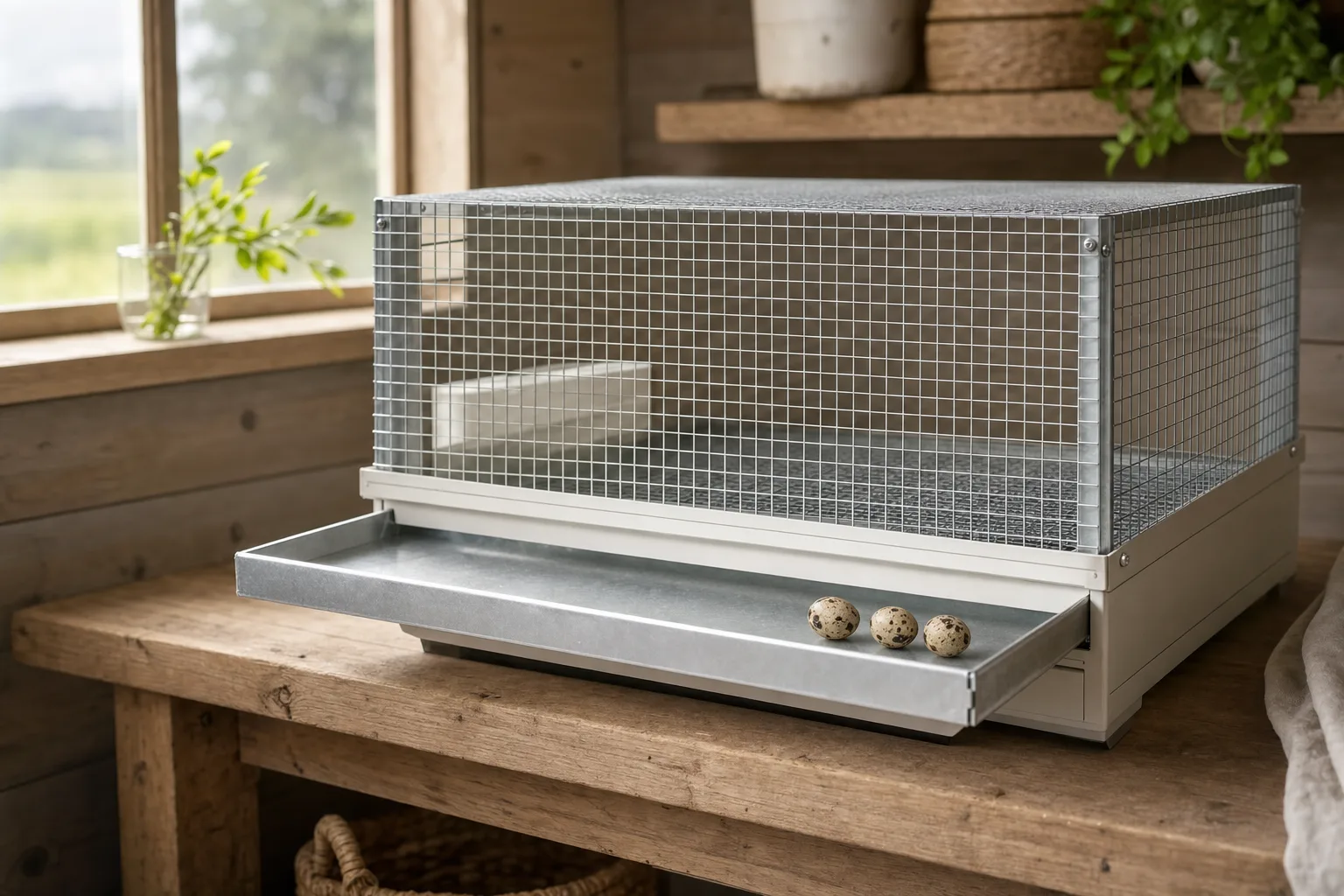
It is a cage with a sloped floor that moves eggs toward a tray outside the bird area. You collect eggs without opening the main door. The Hatching Time one-section and two-section models are purpose-built examples of that sloped path.
Aim for roughly 7–10°. That slope lets eggs travel toward the collection area without making the floor unnecessarily difficult for the birds to stand on. Follow the product instructions for the final setup and keep the floor free of debris.
Start with usable floor area, not the number printed in a product listing. Allow at least 1 ft² (0.09 m²) per bird for a wire cage, with 1.5 ft² kinder. Manufacturer capacity is a maximum claim, not a welfare recommendation.
It can, when the usable floor area and floor design suit them. The Hatching Time jumbo model specifically identifies jumbo flooring, so it is the clearest fit in this group. Still measure each section and use the same 1 ft² minimum or 1.5 ft² kinder target.
Check that the cage is level from side to side, the tray lines up, and bedding or debris is not blocking the path. Look for floor damage, then follow the manufacturer assembly instructions before changing anything.
Yes, several are designed for indoor use. Choose washable surfaces, good airflow, and waste trays you can reach without disturbing the birds. Plan for male noise, since cocks are loudest at dawn, and keep the cage in a suitable sheltered setup.
Use Housing for larger setup questions, browse Feed & Water for drinkers and feeders, and find all Quail Corner guidance in all Quail Corner guides.