 Quail Corner
Best Overall
Hatching Time Quail Breeding Cage Indoor, 2 Section, 1 Layer, Traditional
$$
Check Price on AmazonChoose a compatible Coturnix group, give each bird enough usable floor, collect fertile eggs, then incubate them under controlled settings. This five-step setup is for domestic Japanese quail raised for eggs or meat; bobwhite and wild-quail housing are outside the scope.
A repeatable 5-stage route from parent birds to hatch day
A clearly separated breeding group with a controlled route to the next hatch
Start with one male and four to five females in a separated, low cage. Give every bird at least 1 ft² of wire-cage floor, collect intact eggs, and incubate them at 99.5°F in a forced-air incubator. Turn three to five times daily until lockdown on day 14–15.
Most Coturnix eggs hatch in 17–18 days. Prepare a brooder at 95°F at chick level for week one, then drop the temperature about 5°F each week.
Gather a separated adult cage, an incubator, a brooder, and a simple record sheet before pairing birds. The cage needs enough usable floor and a divider. The incubator needs stable temperature and humidity control, and the brooder must be ready before eggs hatch.
$$
Check Price on AmazonWork in this order: choose birds, ready the cage, set one male with four to five hens, collect labeled eggs, then incubate and brood. The order keeps parent records attached to each egg and gives you time to fix a cramped cage before birds start fighting.
Choose Coturnix hens and a cock that fit your goal, such as keeping a color or selecting larger birds. Keep notes on the parents and avoid mixing groups if you want to track the next generation. Young hens usually begin laying at 6–8 weeks, so confirm the group is mature enough to provide eggs.
Sex wild or Pharaoh-colored birds by feather color at about 3 weeks. Vent assessment is useful at about 6–8 weeks. Give new birds time to settle before you judge the group’s behavior.
Set the cage in a dry, sheltered place with easy daily access. Adult Coturnix need ½ in × ½ in, or 13 mm, hardware cloth for cage flooring. Keep cage height around 8–12 in. A taller cage needs a soft roof because startled birds can hit their heads.
If you are choosing a purpose-built breeder system, compare our quail breeding cage picks before buying. Then use our step-by-step quail cage setup guide for assembly, placement, and daily-access details.
The Hatching Time Quail Breeding Cage Indoor, 2 Section, 1 Layer, Traditional is a useful example of a purpose-built two-section cage. Its listing gives a 23.8 × 17.3 in floor area, two sections, a removable divider, a 1-gallon tank, and roll-out egg collection. That listed footprint works out to about 2.9 ft² before the divider, so it is below the 5 ft² minimum for a full 1:4 group. Check the Hatching Time cage listing
The listing also claims up to 10 standard quail, or 5 smaller or 3 larger birds per section. Treat those as listing specifications and claims only. A divided small cage can help manage groups, yet it cannot replace the floor-space calculation.
Place one male with four to five females. One male to three females is the minimum because extra males fight. Calculate every cage section on its own. A 1:4 group is five birds, so it needs at least 5 ft² of floor at the minimum allowance. A 1:5 group is six birds, so it needs at least 6 ft².
The kinder allowance changes those totals to 7.5 ft² for five birds and 9 ft² for six birds. Round down conservatively. Do not count divider space, trays, seller-marketed totals, or vertical levels. Penn State Extension’s Small Scale Poultry Housing offers general housing context, while these Coturnix figures come from Quail Corner’s facts sheet.
Collect intact eggs from the breeding section and keep the group label with them. A roll-out floor can move eggs clear of the birds quickly, which keeps collection simple. Keep records of the date, parent group, and number of eggs so the hatch has a useful history.
When you are ready to load the incubator, follow our Coturnix incubator settings schedule for the day-by-day handoff.
Run a forced-air incubator at 99.5°F, or 37.5°C. Keep humidity about 45% on days 1–14 and turn eggs three to five times daily, or use automatic turning. Lockdown starts on day 14–15: stop turning and raise humidity to 65–70%.
Most chicks pip within 24 hours of day 17. Leave stragglers until day 19–20. Move fully feathered chicks to grow-out at 3–4 weeks. Start the brooder at 95°F at chick level in week one, then drop it about 5°F per week.
Check the group size, the section floor, and the incubation calendar before birds or eggs move into the system. Those three checks catch the mistakes that cause crowding, fighting, and missed lockdown dates.
Start with the ratio, usable floor, and incubator calendar. A clear egg, a late pip, or a fight usually points you back to one of those checks. If a bird shows illness or injury signs, contact a vet or extension office rather than trying to diagnose the problem yourself.
Check the ratio, the bird’s sex, and the group record first. One male with four to five females is the target, with one male to three females as the minimum because extra males fight. If a bird shows illness or injury signs, contact a vet or extension office.
Keep the incubator closed during lockdown and check the calendar before changing settings. Coturnix usually hatch in 17–18 days, with stragglers left until day 19–20. Confirm the forced-air temperature is 99.5°F and that turning stopped on day 14–15.
Recalculate usable floor for that section and remove any extra male from the group. The minimum is 1 ft² per bird, while 1.5 ft² is kinder. If illness signs appear, contact a vet or extension office.
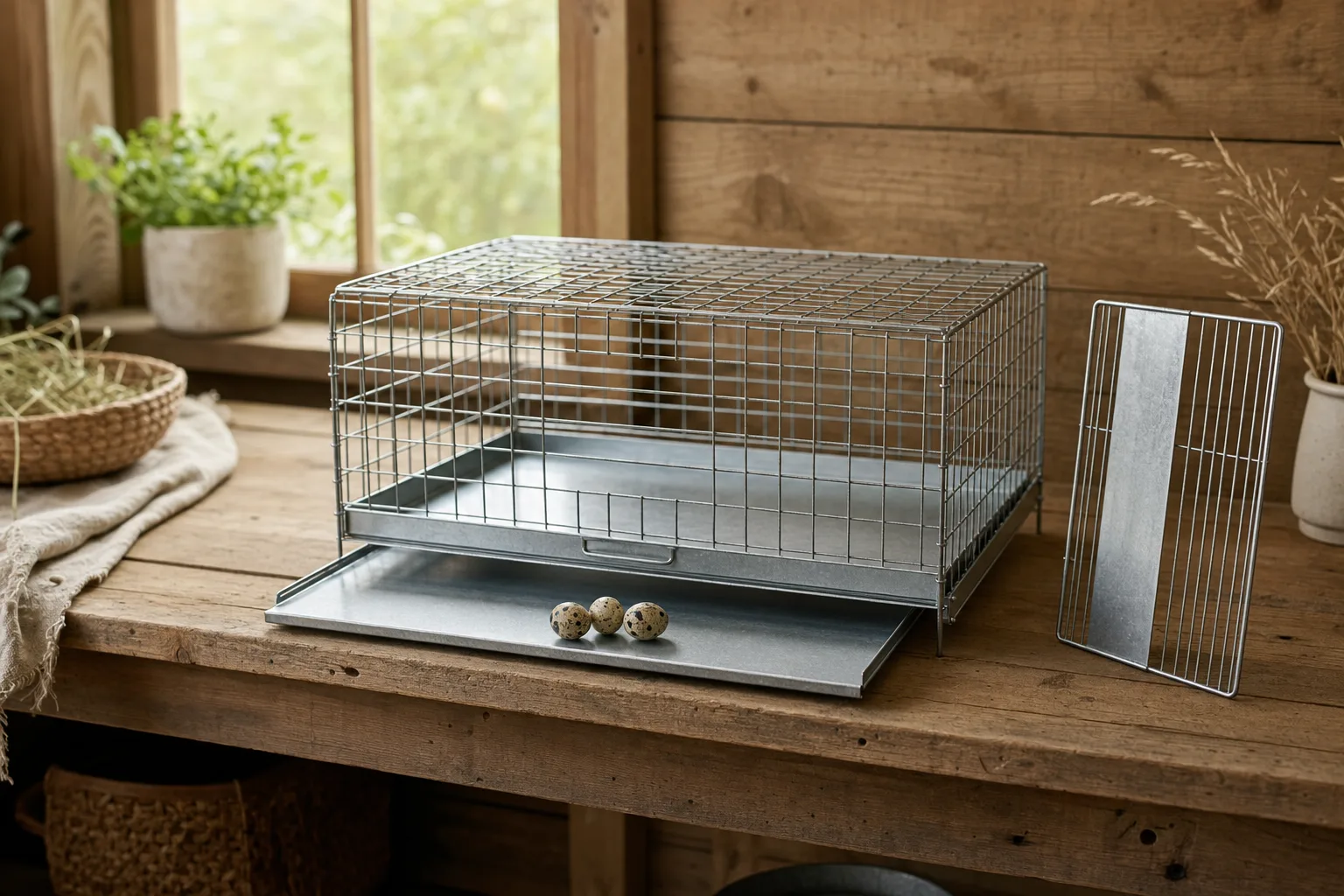
The best cage has enough usable floor area, a safe floor wire, a useful divider, easy access, and shelter from weather. The Hatching Time two-section unit is a purpose-built option with a divider and roll-out collection, though its listing capacity is not a safe stocking recommendation.
Breeder cages keep chosen groups apart for controlled pairings, easier egg collection, and repeatable flock records. Separate sections let you manage more than one group without accidental mixing, which matters when you are selecting for size, color, or another line goal.
The best fit is the cage that meets the floor-space math and safely separates your chosen ratio. A seller capacity alone cannot answer that question. Measure each section’s usable floor and check the floor wire, access, roof, and divider before adding birds.
A stackable cage saves floor footprint, yet each level still needs enough usable floor area. Check stability, access, ventilation, and sheltered placement before stacking. Vertical levels do not add floor area to the section below, and a tall exposed setup needs extra care.
Allow at least 1 ft² per Coturnix in a wire cage, while 1.5 ft² is kinder. Calculate every section separately and round down conservatively. Do not count trays, divider space, vertical levels, or a seller’s advertised total as usable floor.
A breeding group uses one male to four to five females, with one male to three females as the minimum because extra males fight. Removable dividers help keep groups separate, prevent accidental mixing, and give you a way to manage males safely.